Water deeply rather than frequently, delivering moisture 12-18 inches into the soil where tree roots actually grow—not just wetting the surface. A newly planted tree needs 10-15 gallons per week during its first growing season, while established trees require about 10 gallons per inch of trunk diameter. Check soil moisture by pushing a long screwdriver into the ground near the drip line; if it slides in easily, the soil has adequate moisture, but if you meet resistance, it’s time to water.
Apply water slowly at the tree’s drip line, that invisible circle directly beneath the outer reaches of the branches where feeder roots concentrate. A soaker hose circling this zone for several hours works better than a quick spray from above, which mostly evaporates or runs off. For young trees, create a shallow berm of soil around the planting area to hold water in place, letting it soak down gradually rather than rolling away.
Water early morning to minimize evaporation and give foliage time to dry before nightfall, reducing disease risk. During hot summer months, even mature trees show stress through wilting leaves or early leaf drop—signs you need to increase watering frequency. Skip watering when rainfall provides an inch or more per week, and always adjust based on your soil type: sandy soil drains quickly and needs more frequent watering, while clay soil holds moisture longer but requires slower application to prevent runoff.
The difference between a thriving tree and a struggling one often comes down to these watering fundamentals, practiced consistently through that crucial first year and adjusted thoughtfully as your tree matures.
Why Watering Trees Isn’t Like Watering Your Garden
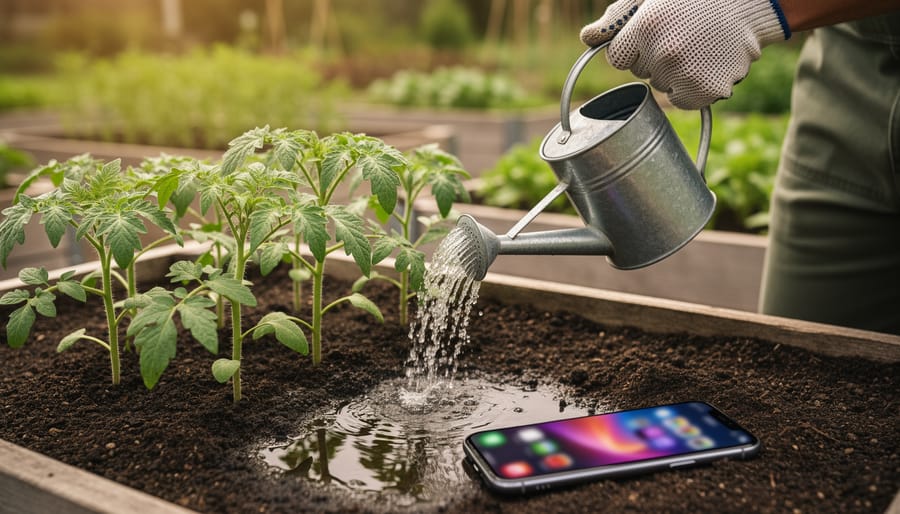
I’ll confess something: I once lost a young oak tree because I treated it exactly like my tomato plants. Every evening, I’d give it a nice drink with my watering can, focusing the water right around its trunk. I felt pretty good about my attentiveness until the leaves started browning and dropping in midsummer. That’s when a neighbor, a retired arborist, gently broke the news that I’d been doing it all wrong.
Here’s what I learned the hard way. Tree roots work completely differently than the roots of your vegetables or perennials. While your garden plants develop relatively compact root systems that stay close to the plant’s base, tree roots spread out horizontally, often extending two to three times beyond the tree’s canopy. Imagine an underground mirror image of the branches above, but stretched even wider. Most of these roots live in just the top 12 to 18 inches of soil, not deep underground like many people assume.
This matters enormously when you’re watering. Those feeder roots that actually absorb water and nutrients? They’re way out at the edges of that root zone, not hugging the trunk where I was dutifully pouring water. Surface watering with a hose or sprinkler might wet the top inch or two of soil, but it rarely penetrates deep enough to reach where trees really drink. Plus, it evaporates quickly, especially in warm weather.
Garden plants with their shallow, concentrated roots can thrive with frequent light watering. Trees, however, need deep, infrequent watering that encourages roots to grow downward and outward. When you water shallowly near the trunk, you’re essentially training the tree to keep its roots at the surface, making it more vulnerable to drought and wind damage.
Understanding this distinction changed everything about how I care for trees, and it can transform your results too.
The Deep Watering Method That Actually Works
How Deep Is Deep Enough?
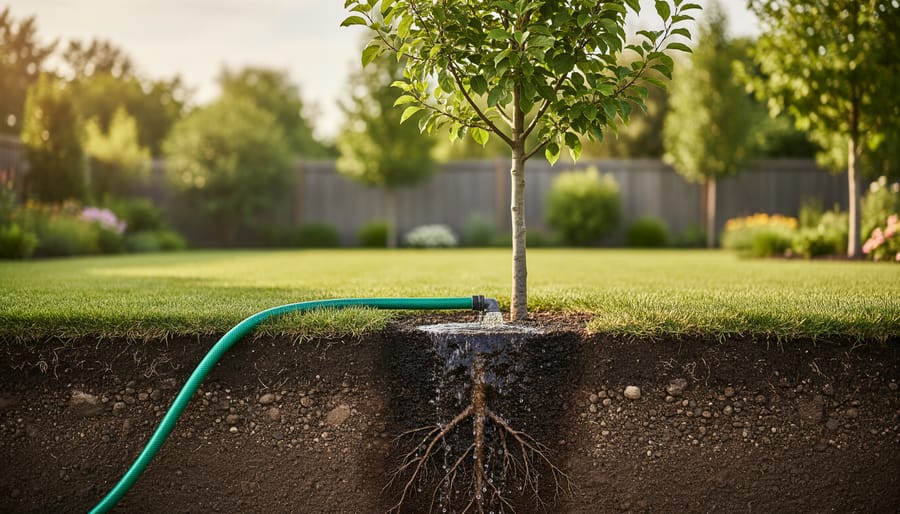
The magic number for tree watering is 12 to 18 inches deep—that’s where most tree roots actively absorb water and nutrients. Surface watering might make the ground look wet, but if moisture isn’t reaching that depth, your tree’s essentially standing at an empty water fountain.
Here’s a simple trick I learned from master gardener Patricia Chen: push a long screwdriver or metal rod into the soil about 24 hours after watering. It should slide in easily through moist soil but stop when it hits dry ground. If it stops at 6 inches, your water isn’t penetrating deeply enough. You can also dig a small test hole with a trowel near (but not directly against) the trunk to visually check moisture levels.
Another effective method is using a soil moisture probe—these inexpensive tools give you accurate readings at various depths. For those who prefer low-tech solutions, simply insert a wooden dowel into the ground, leave it for an hour, then pull it up. The darkened, damp section shows you exactly how far water has penetrated.
Remember, deep watering encourages roots to grow downward where they’re better protected from drought and temperature extremes. Shallow watering creates shallow roots—and that’s a recipe for stressed trees.
Slow and Steady Wins the Race
Here’s the thing about watering trees: it’s not a race! If you’ve ever watched water pool up and run down your driveway instead of soaking into the soil around your tree, you’ve witnessed the problem firsthand. Fast watering means wasted water and thirsty roots.
Trees need slow, deep watering that penetrates the entire root zone. Think of it like this—you want the water to percolate down 12 to 18 inches where those hardworking roots can actually access it. When water flows too quickly, it either runs off the surface or only moistens the top few inches of soil.
So how do you achieve this gentle, effective approach? You have several excellent options:
Drip irrigation systems are my personal favorite. They deliver water at around 1 to 2 gallons per hour, right where you need it. Set them up in a ring around the tree’s drip line (that’s the outer edge of the canopy), and let them run for several hours.
Soaker hoses work beautifully too. Coil them in a spiral pattern around your tree, and they’ll weep water slowly into the soil. The flow rate is similar to drip systems, making them perfect for deep watering sessions.
On a budget? Try the DIY bucket method! Drill four to six small holes (about 1/8 inch) in the bottom of a 5-gallon bucket. Fill it up, place it near your tree, and let gravity do the work. One bucket takes 20 to 30 minutes to empty—exactly the slow pace your tree loves.
Creating a Watering Basin
Creating a watering basin is one of the smartest moves you can make for your tree’s health, and the good news is it’s wonderfully simple! Think of it as building a little swimming pool for your tree’s roots.
Start by identifying your tree’s drip line—that’s the circular area directly beneath the outermost branches. Using a shovel or garden hoe, build a low ridge of soil about 3-4 inches high around this perimeter. You’re essentially creating a donut shape with your tree at the center. The berm doesn’t need to be perfectly uniform; it just needs to hold water.
As you build the ridge, slope the soil gently inward toward the trunk so water flows toward the root zone rather than away from it. Pack the soil down firmly with your hands or the back of your shovel to prevent it from washing away during watering.
For newly planted trees, you might want to create a smaller basin closer to the trunk initially, then expand it outward as the tree establishes and grows. Test your basin by filling it with water and watching how it behaves—adjust any low spots where water escapes. This simple structure ensures every drop counts, directing precious moisture exactly where your tree needs it most.
How Much Water Does Your Tree Actually Need?
Newly Planted Trees (Years 1-2)
The first two years are absolutely critical for your newly planted tree’s survival, so think of yourself as its personal caretaker during this time! Your young tree needs consistent moisture to develop a strong root system that will support it for decades to come.
During the first growing season, water your tree two to three times per week if there’s no significant rainfall. Each watering session should deliver about 10-15 gallons of water, depending on the tree’s size. A good rule of thumb is to provide 2-3 gallons per inch of trunk diameter. The goal is to keep the soil consistently moist but never waterlogged—imagine a wrung-out sponge.
In the second year, you can gradually reduce frequency to once weekly, as the roots are establishing deeper into the surrounding soil. Continue this schedule throughout the growing season, adjusting for rainfall and hot weather. Summer heat waves might require additional watering sessions.
Here’s a tip from master gardener Patricia Henderson: “Create a watering basin around the tree by building up a ring of soil about 2-3 feet from the trunk. This helps direct water to the roots rather than letting it run off.” Remember that caring for specific trees may require slight adjustments to these guidelines, but consistency remains key for all young trees.
Established Trees (Year 3+)
Good news—once your trees reach year three, they’re much more self-sufficient! Their extensive root systems can tap into deeper soil moisture, so you’ll water less frequently but still deeply when you do. During active growing seasons in spring and summer, established trees typically need a thorough soaking every two to four weeks if there’s no significant rainfall. Think of it as mimicking nature’s patterns rather than following a rigid schedule.
Here’s where paying attention really matters: sandy soil drains quickly and may require more frequent watering, while clay soil holds moisture longer. During hot, dry spells or drought conditions, even mature trees appreciate supplemental water—watch for wilting leaves or leaf drop as signs they’re thirsty. In contrast, during rainy periods, you can skip watering entirely.
I like to check soil moisture at 6-8 inches deep using a long screwdriver or moisture probe. If it slides in easily and comes out with moist soil clinging to it, you’re good. If it’s dry and hard to push in, it’s time to water.
Adjust your approach seasonally, too. Trees need less water as they enter dormancy in fall and winter, though evergreens still benefit from occasional deep watering during dry winter months. Remember, established doesn’t mean invincible—stay observant and responsive to your tree’s signals.
The Finger Test You Need to Know
Before you water, here’s the simplest trick in the gardening handbook: stick your finger into the soil near your tree’s base. Push down about 2-3 inches (or up to your second knuckle if you prefer a handy measurement guide). If the soil feels moist, hold off on watering. If it’s dry and crumbly, your tree is thirsty and ready for a drink.
I learned this technique from a master gardener who told me, “Your finger is the most reliable moisture meter you’ll ever own, and it’s free!” She was absolutely right. This quick check takes just seconds and prevents the most common watering mistake: overwatering. Many well-meaning gardeners water on a rigid schedule without checking actual soil conditions, which can lead to root rot and other problems.
For larger or established trees, you might want to check in multiple spots around the drip line—that’s the area beneath the outer reaches of the branches where water naturally drips off.
Best Tools and Techniques for Efficient Tree Watering
Soaker Hoses and Drip Irrigation
For trees that need consistent moisture—especially newly planted ones—soaker hoses and drip irrigation systems are game-changers. These methods deliver water directly to the root zone at a slow, steady pace, allowing it to soak deep into the soil rather than running off the surface. I’ve found they’re particularly helpful when you’re juggling a busy schedule, since you can set them up and let them work their magic while you handle other garden tasks.
Soaker hoses are budget-friendly rubber or canvas tubes with tiny pores that weep water along their entire length. Simply coil them around the tree’s drip line, turn on the water to a gentle trickle, and let them run for an hour or two. Drip irrigation systems offer more precision with adjustable emitters that target specific spots, perfect if you’re watering multiple trees or have varied terrain.
Both options reduce water waste by up to 50 percent compared to sprinklers and minimize fungal diseases by keeping foliage dry. Start checking soil moisture regularly to find your ideal watering duration for your specific setup.
Gator Bags and Tree Watering Bags
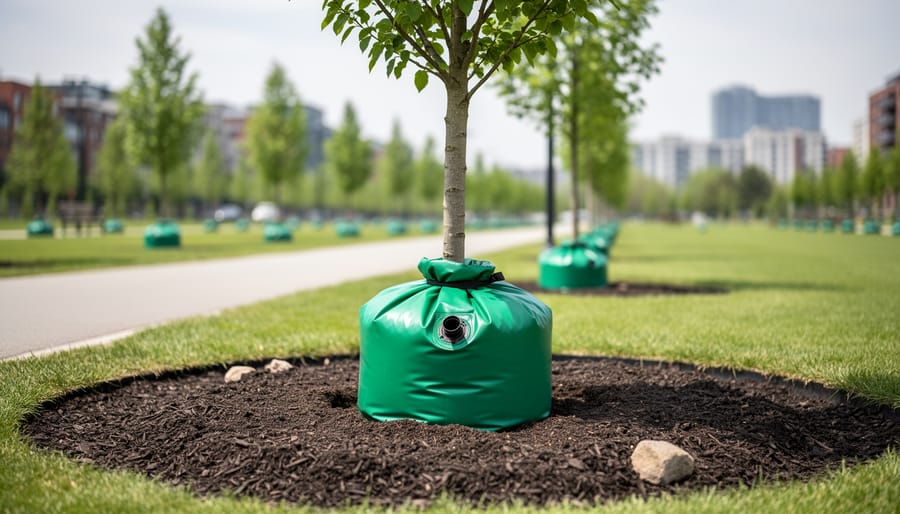
If you’ve just planted a new tree, gator bags (also called tree watering bags) can be absolute lifesavers. These ingenious bags zip around your tree’s trunk and hold anywhere from 15 to 20 gallons of water. Here’s what makes them brilliant: tiny holes in the bottom release water slowly over 5-9 hours, giving your tree’s roots time to actually absorb the moisture instead of watching it run off across your yard.
I’ve found them particularly helpful during those first critical two years when newly planted trees are establishing their root systems. Simply fill the bag with your hose once or twice a week, and it does the hard work for you. They’re especially useful if you travel frequently or tend to forget watering schedules. The slow release mimics deep soaking without requiring you to stand there holding a hose. Plus, during hot summer months, they reduce water waste from evaporation. While they’re not necessary for established trees with deep roots, they’re genuinely worth considering for new plantings.
The Good Old Garden Hose Method
Sometimes the simplest tools work best, and your trusty garden hose is perfect for watering trees. The key is using the trickle method, which mimics a gentle, soaking rain that trees love. Simply turn your hose on low, just enough to create a steady trickle about the width of a pencil, and place it at the base of your tree. Let it run for 20-30 minutes for young trees, or 45-60 minutes for established ones.
You can move the hose around to different spots within the drip line to ensure even coverage. I like to set a timer on my phone so I don’t forget and accidentally flood the area. Investing in quality hose attachments with adjustable flow settings makes this method even easier. The beauty of this approach is its flexibility—you can water multiple trees in one morning by simply repositioning your hose every half hour.
Signs Your Tree Is Getting It Wrong
When You’re Drowning Your Tree
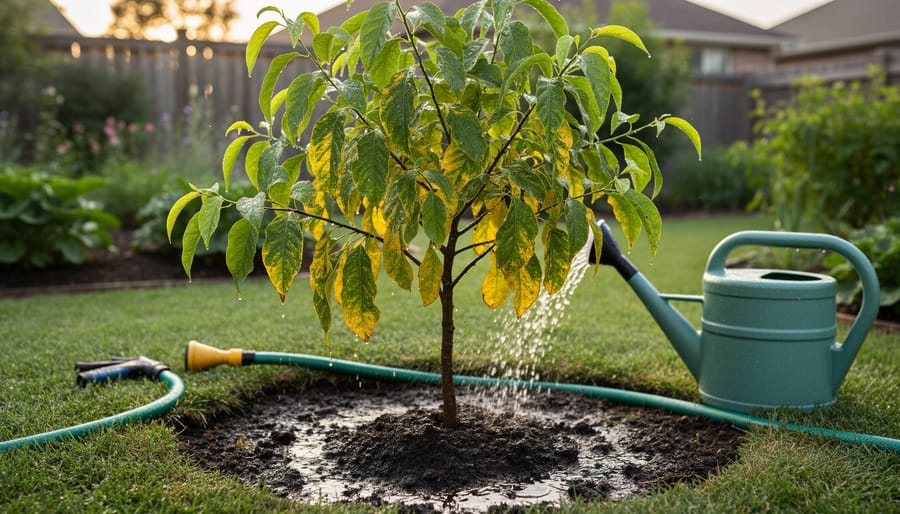
Too much love can actually harm your tree, and the signs are pretty easy to spot once you know what to look for. Yellowing leaves, especially when they’re still attached and haven’t dropped yet, are often your first clue that roots are sitting in waterlogged soil. You might also notice the leaves feel soft or wilted despite the soil being wet—a confusing signal that the roots can’t absorb oxygen.
Take a closer look at the base of your tree. Soft, spongy bark or dark discoloration around the trunk suggests root rot has begun. Fungal growth, including mushrooms sprouting near the base, indicates excessive moisture creating a playground for decay organisms. The soil itself might have a sour or unpleasant smell, quite different from healthy, earthy-smelling dirt.
I learned this the hard way with a young maple that developed these exact symptoms. Once I backed off watering and improved drainage, it recovered beautifully. Your tree is remarkably resilient when given the chance to dry out properly.
When Your Tree Is Parched
Trees are pretty good at telling us when they’re thirsty, if we know what to look for. The first sign I usually notice is wilting leaves, even in the cooler morning hours. When a tree can’t draw enough moisture from the soil, its leaves lose that healthy, perky appearance and start to droop.
Take a closer look at the leaf edges too. Brown, crispy margins that seem to creep inward are a telltale sign your tree needs more water. You might also notice leaves dropping earlier than they should, especially on younger trees. This premature leaf drop is your tree’s survival mechanism, reducing the foliage it needs to support when water is scarce.
The overall appearance of an underwatered tree looks stressed and lackluster. Growth slows down noticeably, and new shoots may be smaller than usual. I’ve learned that catching these signs early makes all the difference. Once you recognize them, you can adjust your watering schedule before your tree suffers serious damage. Remember, consistent observation is your best tool for keeping trees healthy and hydrated.
Seasonal Watering Adjustments That Make All the Difference
Your tree’s water needs shift dramatically with the seasons, and recognizing these changes is key to keeping your trees thriving year-round. Think of it as adjusting your own wardrobe—what works in July won’t cut it in January!
During summer’s heat, your trees are working overtime. They’re actively growing, supporting full canopies, and battling moisture loss through their leaves. This is when deep, consistent watering becomes crucial. In hot climates, you might need to water twice weekly, while cooler regions may require less frequent sessions. Watch for signs of stress like wilting leaves or premature leaf drop, and adjust accordingly. This is where smart water management really pays off—you’ll save water while keeping trees healthy.
As fall approaches, your watering strategy should shift too. Trees are preparing for dormancy, so they need less frequent watering, but don’t stop completely. A deeply watered tree heading into winter is better equipped to handle freezing temperatures and drying winds. I like to give my trees one final thorough soaking after the leaves drop but before the ground freezes.
Winter watering often surprises people. In regions with dry winters and no snow cover, evergreens especially benefit from occasional watering during warm spells when the ground isn’t frozen. Deciduous trees need less attention but shouldn’t be completely forgotten during extended dry periods.
Come spring, your trees wake up thirsty. As buds swell and new growth emerges, gradually increase your watering frequency. This is also when newly planted trees need extra attention as they establish roots.
Remember, your location matters enormously. A tree in Arizona faces different challenges than one in Maine. Observe your own trees—they’ll tell you what they need through their appearance and growth patterns. Your best teacher is always right in your own backyard.
Here’s the wonderful truth about watering trees: you don’t need to be perfect, you just need to be present. As you’ve learned throughout this guide, proper tree watering isn’t about memorizing complicated formulas or investing in expensive equipment. It’s about developing a relationship with your trees through consistent care, patient observation, and a willingness to adjust as you learn what works in your unique environment.
Think of tree watering as part of your broader essential garden maintenance routine. The more time you spend with your trees, checking the soil moisture, observing their foliage, and noticing how they respond to your care, the more intuitive this practice becomes. What feels uncertain now will gradually transform into confident knowledge as you recognize the subtle signs your trees are showing you.
Start small if you need to. Pick one technique from this article and try it this week. Maybe it’s testing soil moisture before watering, or adjusting your watering schedule based on the season. Each small step builds your skills and strengthens your trees.
Remember, healthy, thriving trees are absolutely worth the effort. They’ll reward your dedication with years of beauty, shade, and environmental benefits. Trust yourself, stay curious, and know that every gardener who successfully nurtures magnificent trees started exactly where you are today. Your trees are counting on you, and you’ve got this.