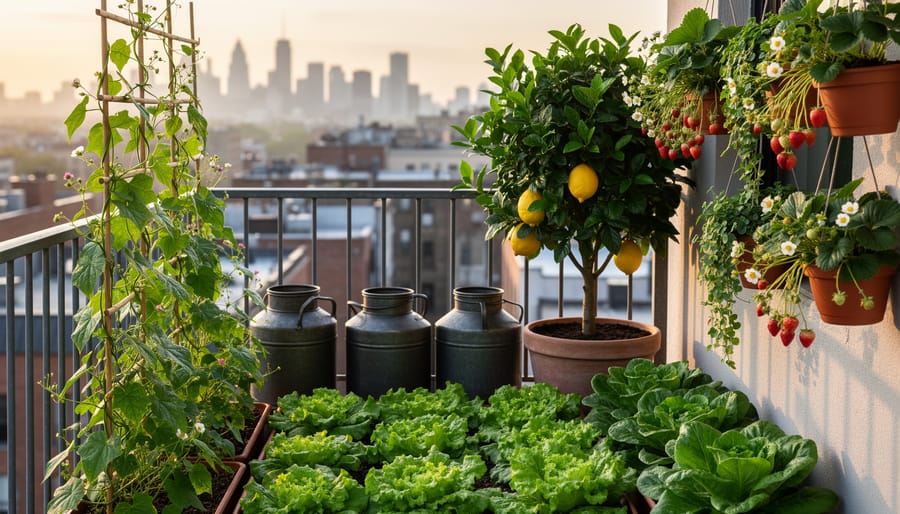
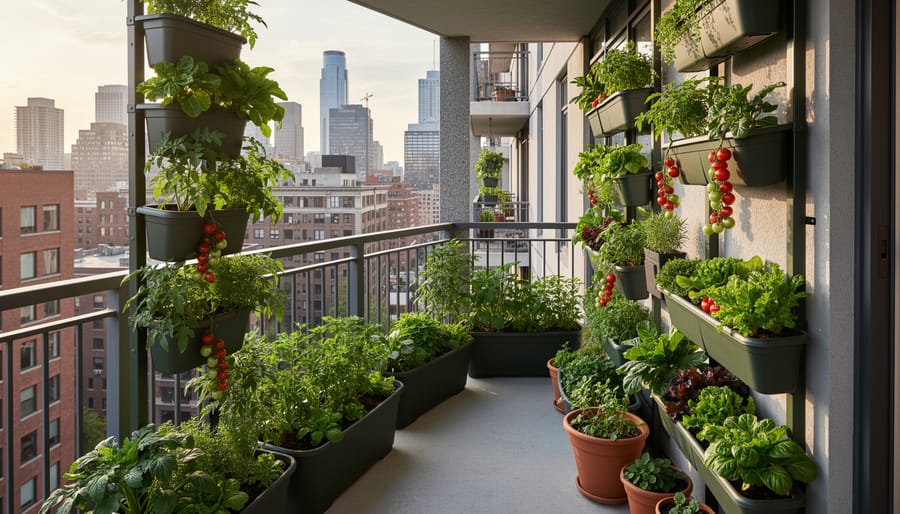
Transform your balcony railing into a vertical food forest by stacking climbing beans with trailing strawberries and ground-level lettuce, mimicking nature’s layered approach to maximize every square inch. Stack functions by choosing plants that serve multiple purposes—a dwarf lemon tree provides fruit, fragrance, and privacy screening while its dropped leaves mulch surrounding herbs. Catch and store energy by placing dark-colored water containers behind south-facing plants to absorb daytime heat and release warmth during cool nights, extending your growing season by weeks.
Create closed-loop systems in containers by layering cardboard at the bottom, adding kitchen scraps mixed with shredded newspaper, then topping with quality soil—your plants feed themselves as organic matter breaks down. Position taller plants on the north side of your space and cascade downward to shade-lovers, ensuring nothing blocks precious sunlight. Observe your microclimates before planting by noting which corners stay moist, where wind whips through, and which walls radiate heat—then match plants to these conditions rather than fighting them.
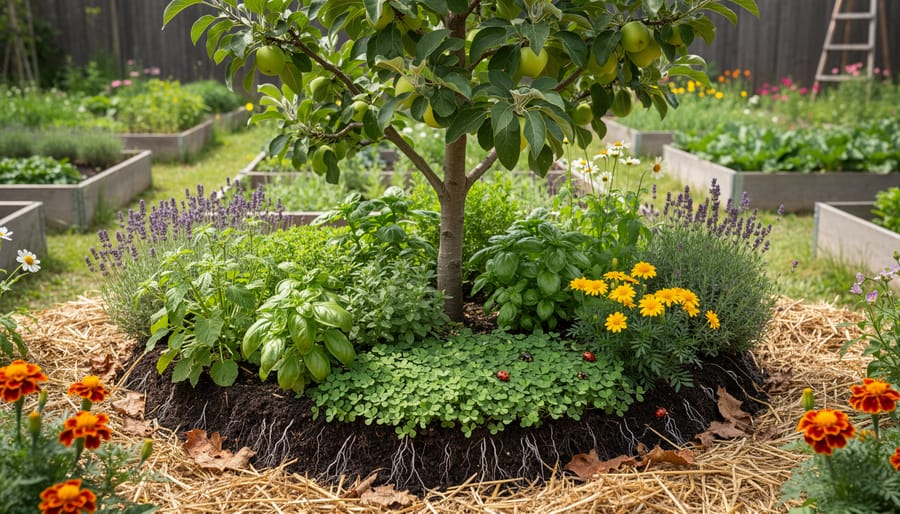
Build soil fertility by maintaining a small worm bin under your kitchen sink, transforming coffee grounds and vegetable peels into liquid fertilizer and rich castings within months. Edge your patio containers with nitrogen-fixing clover or alyssum that feeds beneficial insects while improving soil for neighboring vegetables. These practices work because they follow nature’s blueprint—systems that regenerate resources, minimize waste, and create abundance through thoughtful design rather than constant inputs.
What Makes Permaculture Different in the City
You might think permaculture requires acres of farmland, but here’s the exciting truth: the core principles of permaculture work beautifully in the city, they just need a bit of creative adaptation.
At its heart, permaculture is about working with nature instead of fighting against it. In urban spaces, this means observing how sun, wind, and water move through your balcony or backyard before placing a single plant. I learned this the hard way when I tried growing tomatoes on the shady side of my apartment balcony. Once I moved them to the sunny railing, they thrived without any extra effort on my part.
One of the most powerful urban permaculture concepts is stacking functions, where each element serves multiple purposes. A vertical trellis doesn’t just support climbing beans; it also creates privacy, blocks afternoon heat, and produces food. Your rain barrel isn’t only collecting water; it’s reducing runoff and providing a habitat for beneficial insects around its base. This efficiency matters tremendously when you’re working with limited square footage.
City permaculture also embraces closed-loop systems, where waste becomes a resource. Your kitchen scraps feed a small compost bin that enriches container soil, which grows vegetables whose trimmings return to the compost. Nothing leaves your little ecosystem.
The difference from conventional urban gardening is subtle but significant. Instead of fighting your environment with chemicals and constant intervention, you’re creating relationships between plants, insects, and materials that support each other. Your basil protects tomatoes from pests. Your marigolds attract pollinators that help your beans. Your mulch feeds the soil while conserving precious water.
Even the smallest balcony can become a miniature ecosystem following these principles, producing food while requiring less work over time.
Zone Planning for Your Urban Space
Making Every Square Foot Count
When you’re working with limited space, every square foot becomes precious real estate for growing. The good news? Small spaces can be surprisingly productive when you think creatively about how to use them.
Start by looking up. Vertical gardening is your best friend in compact areas. Trellises, wall-mounted planters, and hanging baskets instantly multiply your growing area without taking up floor space. I’ve seen balconies transformed with climbing beans, cucumbers, and even small melons growing happily upward on simple bamboo frames. Stack containers at different heights to create layers of productivity, and consider pocket planters that attach to walls or railings.
Container placement deserves careful thought. Take a weekend morning to observe how sunlight moves across your space throughout the day. You might discover that one corner gets six hours of sun while another stays shaded, perfect for lettuce and herbs that prefer cooler conditions. These microclimates are goldmines for urban permaculture practitioners.
Don’t forget about your vertical surfaces themselves. South-facing walls often create warm microclimates ideal for heat-loving tomatoes and peppers, while north-facing spots suit shade-tolerant greens. Even the space beneath elevated containers can house shade-loving plants or act as cool storage for root vegetables in pots.
Group your containers strategically, placing taller plants where they’ll provide afternoon shade for cool-season crops. This companion stacking mimics natural forest layers in miniature, making your small space work harder while creating a lush, productive mini-ecosystem.
Your Kitchen Window is Zone 1
Your kitchen window or the area right outside your back door is prime real estate in permaculture terms. This is where you’ll want to grow everything you reach for daily. Think fresh herbs like basil, cilantro, parsley, and chives—the ones you pinch constantly while cooking. I keep mine in pots on my windowsill, and it’s made such a difference not having to run to the store for wilted herbs.
Salad greens are another Zone 1 essential. Lettuce, arugula, and spinach grow quickly in containers and you can harvest leaves as needed. Just snip what you need for tonight’s salad and let the plant keep growing. It’s incredibly satisfying and saves money too.
Don’t forget frequently used vegetables like cherry tomatoes, green onions, and small peppers. These thrive in pots and produce over a long season. The key is convenience—if you need to trek across your yard in the rain, you probably won’t bother. But when these ingredients are just steps away, you’ll find yourself cooking with fresh produce almost without thinking about it. Start small with three or four favorites, then expand as you discover what you use most.
Stacking Functions Like a Pro
Plants That Do Double (or Triple) Duty
One of permaculture’s most satisfying principles is choosing plants that work overtime in your space. Why settle for a single purpose when some plants can juggle multiple roles beautifully?
Let’s start with nitrogen-fixers that also produce food. Scarlet runner beans are perfect for urban gardens, climbing trellises on balconies or patios while feeding your soil and your family. Their vibrant red flowers attract pollinators like crazy, and the beans are delicious. Peas work similarly in cooler seasons, fixing nitrogen while providing early spring harvests.
For larger spaces like small yards, consider fruit trees that create shade. A dwarf mulberry tree fits into modest gardens while producing abundant fruit and providing a cooling canopy underneath for shade-loving plants like lettuce or herbs. Similarly, a compact fig tree offers shade, food, and even large leaves that make excellent mulch.
Don’t overlook comfrey, which I call the workhorse of permaculture gardens. Plant it in a container if you’re worried about spread, and it’ll reward you with deep-rooted nutrient mining, endless mulch material, and pollinator-friendly flowers. You can chop it back multiple times per season to feed other plants.
Herbs like nasturtiums are brilliant multitaskers too. They’re edible, attract beneficial insects, can act as living mulch, and some varieties even climb. Plus, they thrive in containers, making them ideal for balcony gardeners.
The key is thinking beyond traditional single-purpose planting and embracing these hardworking varieties that maximize every inch of your urban growing space.
Making Your Furniture Work Harder
In urban permaculture, every element should serve multiple purposes, and that includes your outdoor furniture. Think beyond traditional uses and discover how simple structures can transform your space while supporting your garden ecosystem.
Trellises are fantastic multitaskers. Position a sturdy trellis along your balcony railing or patio edge, and you’ve created instant privacy while providing vertical growing space for climbing beans, peas, or cucumbers. I’ve seen gardeners use decorative lattice panels that look beautiful year-round, even when plants are dormant.
Raised beds become inviting seating areas when you design the edges wide enough to perch on. Build your bed walls about 18 inches wide using sturdy timber or composite materials, and suddenly you have comfortable spots for morning coffee while checking on your tomatoes. Adding cushions makes them even more welcoming for guests.
Compost bins don’t need to hide in the corner. Modern tumbler-style composters or attractive wooden bin systems can integrate seamlessly into your outdoor living area. Place one near your outdoor dining space, and it becomes a conversation starter about sustainability while making it incredibly convenient to scrape plates directly into your composting system. These dual-purpose designs maximize every square foot while creating a cohesive, functional garden space.
Water Wisdom for Urban Permaculture
Simple Rainwater Harvesting You Can Start Today
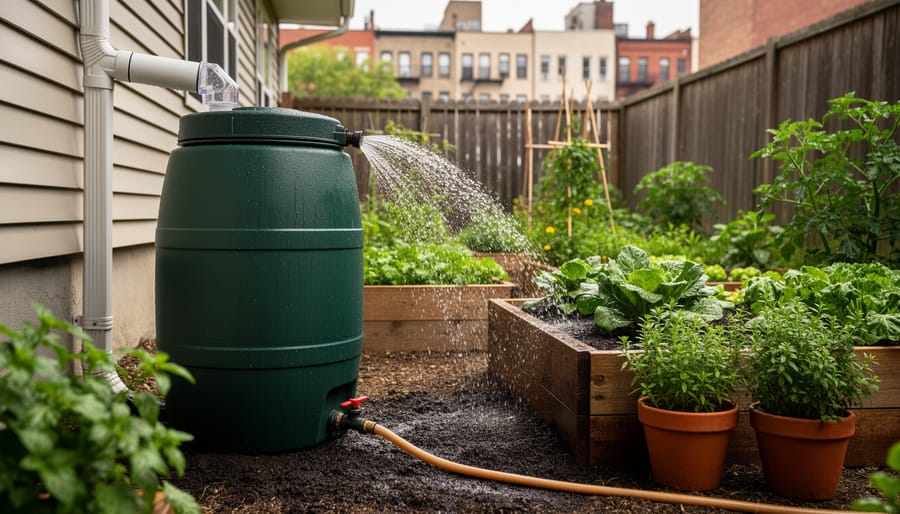
Capturing rainwater is one of the simplest permaculture practices you can implement today, regardless of whether you rent or own. You’re basically letting nature do the work while you reap the benefits of free, chemical-free water for your plants.
Let’s start with the easiest option: container collection. Simply place a food-grade barrel, large bucket, or even a clean trash can beneath your downspout. If you’re renting, this no-installation approach means you can take your system with you when you move. For added functionality, look for containers with spigots near the bottom, making it easy to fill watering cans without lifting heavy buckets.
Downspout diverters are your next level up and they’re wonderfully renter-friendly too. These clever devices redirect water from your gutter into your collection container, and most install without permanent modifications. When your barrel fills up, the diverter automatically sends excess water back through the downspout. You can find these at most hardware stores for under thirty dollars.
Here’s a quick setup guide: Position your container on a stable, level surface near a downspout. If using a diverter, attach it according to package instructions, typically just cutting the downspout and inserting the device. Add a screen or mesh over the top to keep out debris and mosquitoes. That’s it.
Start small with one or two containers and watch how quickly they fill during rain showers. You’ll be amazed at how much water flows off even a small roof section, providing plenty for your urban garden throughout drier spells.
Building Soil in Containers and Small Beds
Composting Without a Backyard
Living in an apartment doesn’t mean you have to miss out on composting! I discovered this firsthand when I moved to a small city apartment and thought my composting days were over. Fortunately, several indoor-friendly methods make it possible to turn kitchen scraps into nutrient-rich soil amendments, even in the tiniest spaces.
Bokashi composting is a fantastic option for apartment dwellers. This Japanese method uses a special bucket with an airtight lid and beneficial microorganisms to ferment food waste, including meat and dairy. The process is completely odorless when done correctly, and you can keep the bucket right under your kitchen sink. Within two weeks, you’ll have pre-compost that can be buried in a community garden plot or added to outdoor containers.
Vermicomposting, or worm composting, is another space-efficient solution. A small worm bin can fit under your sink or in a closet, and red wiggler worms happily consume your vegetable scraps while producing rich castings. I interviewed urban gardener Maria Chen, who keeps her worm bin on her apartment balcony year-round. “My worms have never caused any smell or pest issues,” she shared. “They’re actually quieter roommates than my cat!”
Don’t overlook community composting programs either. Many cities now offer drop-off locations or curbside collection for organic waste. Some programs even provide finished compost back to participants, creating a wonderful closed-loop system. Check with your local environmental organizations or farmers markets to find programs near you.
Creating Urban Food Guilds
A Three Sisters Guild for Containers
The Three Sisters guild—corn, beans, and squash—is a beautiful example of companion planting that you can absolutely recreate in containers! While traditional gardens plant these directly in the ground, urban gardeners have successfully adapted this centuries-old technique for patios and balconies.
Here’s how it works in a container: Choose a large pot (at least 20 gallons) and plant a compact corn variety in the center. Once the corn reaches about six inches tall, add pole beans around it—they’ll climb the corn stalks as natural trellises. Finally, plant a compact squash or trailing nasturtiums around the edges. The beans fix nitrogen in the soil, feeding the heavy-feeding corn and squash, while the squash leaves shade the soil and reduce water evaporation.
For smaller spaces, try a modified version: swap corn for a bamboo tepee or trellis, keep the climbing beans, and use trailing herbs like oregano instead of space-hogging squash. You could also experiment with tomatoes, basil, and marigolds—they follow the same mutual support principle.
The key is understanding the relationship: one plant provides structure, another enriches the soil, and the third protects it. Once you grasp this pattern, you can create countless container guilds tailored to your favorite vegetables and available space.
Supporting Wildlife in Your Urban Oasis
Creating a thriving wildlife habitat in your urban space isn’t just possible—it’s one of the most rewarding aspects of urban permaculture. You’d be amazed at how quickly beneficial creatures discover even the smallest garden oasis.
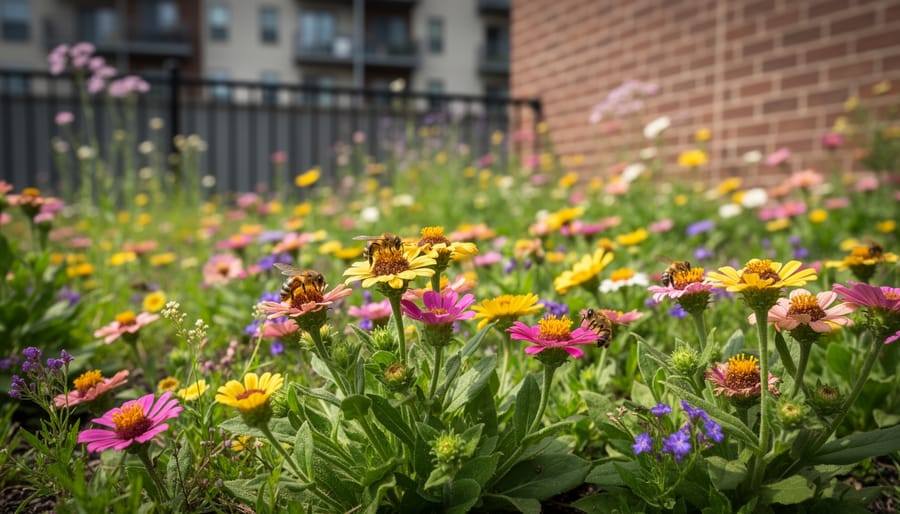
Start by thinking of your space as a mini ecosystem. Pollinators like bees and butterflies need three things: food, water, and shelter. A shallow dish with pebbles and water serves as a perfect drinking station, while leaving a small patch unmulled or creating a bundle of hollow stems provides nesting spots for solitary bees.
Native plants are your secret weapon here. They’ve evolved alongside local wildlife and require far less maintenance than exotic species. In urban settings, consider plants like coneflowers, black-eyed Susans, or native salvias for pollinators. These tough plants handle container growing beautifully and don’t mind the reflected heat from buildings.
I spoke with urban gardener Maria Chen, who transformed her Chicago balcony into a pollinator paradise. “I started with just three native plants in containers,” she shared. “Within two weeks, I counted five different butterfly species. It felt like magic, but it’s really just about giving nature what it needs.”
Layer your plantings to create diverse habitats. Tall sunflowers offer bird perches, mid-height herbs provide nectar, and low-growing ground covers shelter beneficial beetles that eat aphids. Leave some leaf litter in corners—it’s not messy, it’s habitat for helpful insects.
Avoid pesticides completely. Urban wildlife faces enough challenges without chemical exposure. Instead, let your wildlife helpers handle pest control naturally. That ladybug on your tomato plant? She’ll devour hundreds of aphids without any effort from you. Working with urban wildlife means trusting nature’s balance, even in the smallest spaces.
Getting Started Without Overwhelm
Here’s the wonderful truth: starting with permaculture doesn’t require overhauling your entire space in one weekend. In fact, the core principle of permaculture is observation, which means your first step is simply to watch and learn from your environment. Spend a week noticing where sunlight hits your balcony, which corners stay damp, or where wind tends to blow strongest. This observation period is your foundation.
Begin with one small project. Perhaps it’s creating a simple herb spiral in a large container, or establishing a worm composting bin under your sink. These manageable steps build confidence and teach you valuable lessons without overwhelming your schedule or budget. Remember, permaculture pioneer Bill Mollison often said that the problem is the solution—every challenge in your urban space holds an opportunity.
Connect with your local permaculture community through workshops, online forums, or garden clubs. These connections provide invaluable support and inspiration. Many cities have permaculture design courses specifically tailored for urban settings, and countless free resources exist through library books and reputable gardening websites.
The beauty of permaculture lies in its forgiving nature. There’s no perfect way to start, and mistakes become learning opportunities. That shady corner you thought was useless? It might be perfect for growing mushrooms or shade-loving greens. Each small change you make compounds over time, creating a thriving ecosystem that requires less work while producing more abundance. Your urban permaculture journey is uniquely yours—embrace the adventure.
You’ve taken the first steps into a world where even the smallest urban space can become a thriving ecosystem. Whether you’re working with a tiny balcony, a modest patio, or a compact backyard, permaculture principles help you create regenerative abundance right where you are. Remember, every container garden, every vertical planter, and every composting system contributes to healthier soil, cleaner air, and more resilient communities.
Don’t feel pressured to implement everything at once. Start with one practice that excites you, observe what happens, and build from there. Connect with fellow urban gardeners through local permaculture groups, community gardens, or online forums. Share your successes and learn from your experiments, knowing that each mistake teaches you something valuable about your unique microclimate.
You’re now part of a rapidly growing movement of urban permaculturists transforming cities into productive, beautiful, and ecologically sound spaces. Your balcony garden, rooftop oasis, or backyard food forest isn’t just feeding you, it’s inspiring neighbors, supporting pollinators, and proving that sustainability starts right at home. Keep growing, keep learning, and celebrate every harvest along the way.