You’ve just received your soil test results, and there are two pH numbers staring back at you. Which one matters? The answer: both, but they tell you completely different stories about your soil.
Soil pH measures your ground’s current acidity or alkalinity right now—think of it as today’s snapshot. Buffer pH, on the other hand, reveals your soil’s resistance to change, showing how much lime you’ll actually need to raise that pH to your target level. This second number exists because soil contains materials like clay and organic matter that fight against pH adjustments, much like a buffer fights pH changes in a swimming pool.
Here’s where gardeners get tripped up: you can’t simply add lime based on soil pH alone. Two gardens might both test at 5.5 pH, but one with high buffering capacity could need three times more lime than the other to reach 6.5. That’s money wasted or plants that still struggle in acidic conditions.
Understanding both measurements transforms you from someone guessing at amendments to a gardener who knows exactly what your soil needs. The soil pH tells you where you are, the buffer pH tells you how to get where you’re going, and together they become your roadmap to healthier plants and better harvests.
What Soil pH Actually Measures (And What It Doesn’t)
Think of soil pH as taking your garden’s temperature—it gives you a reading at this exact moment, but it doesn’t tell you everything about what’s happening beneath the surface. When you test your soil’s pH, you’re measuring how acidic or alkaline the water portion of your soil is right now, on a scale from 0 to 14. Numbers below 7 are acidic, 7 is neutral, and above 7 is alkaline.
Here’s what makes this interesting: soil pH is like a snapshot from your phone. It captures what’s happening at that precise moment, but it won’t predict what happens next or show you what happened yesterday. If you’ve just watered with acidic rainwater or added lime last week, your pH reading reflects those recent changes.
So why do we gardeners care so much about this number? Because pH acts as a gatekeeper for nutrients. When soil pH swings too far in either direction, certain nutrients get locked up and become unavailable to plant roots, even if they’re present in the soil. At a pH around 6.5, most garden plants can access the widest buffet of nutrients. Drop down to 5.0, and suddenly calcium becomes scarce. Climb up to 8.0, and iron goes missing from the menu.
You can explore basic soil testing methods to check your pH at home. The relationship between soil microbes and pH is equally important—beneficial organisms thrive best within specific pH ranges.
But here’s the catch: pH alone doesn’t reveal how easily your soil will resist changes or how much amendment you’ll need to adjust it. That’s where buffer pH enters the picture.
The Problem with Standard pH Tests
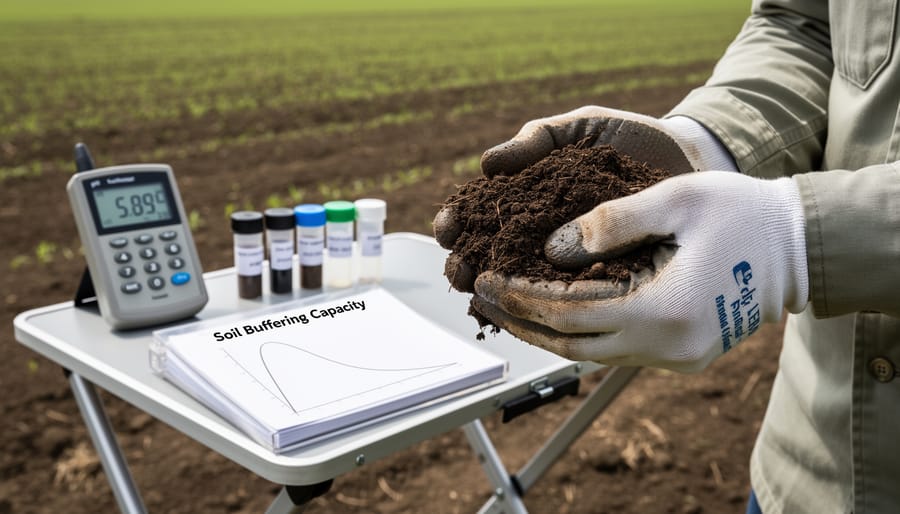
You’ve probably been there: you send off your soil sample, eagerly await the results, and discover your pH is too acidic for those beautiful hydrangeas you’ve been dreaming about. So you follow the standard advice, spread some lime across your garden beds, and wait. Weeks pass, maybe even months, and you test again. Frustratingly, the pH has barely budged!
This scenario plays out in gardens everywhere, and it’s not because you did anything wrong. The challenge is that standard pH tests only tell you part of the story. They measure the active acidity in your soil at that precise moment, but they don’t reveal how stubbornly your soil will resist change.
Think of it this way: some soils are like a gentle stream that easily changes direction, while others are like a mighty river that takes tremendous force to redirect. You might have soil with a pH of 5.5, and your neighbor might also have soil at 5.5, but your soil might need twice as much lime to reach the same target pH. Why? Because your soils have different capacities to resist pH changes.
This resistance comes from something called buffering capacity, and understanding it is the key to successfully adjusting your soil pH without wasting time, money, and effort on amendments that seem to disappear without effect.
Buffer pH: Your Soil’s Hidden Resistance
What Buffer pH Measures
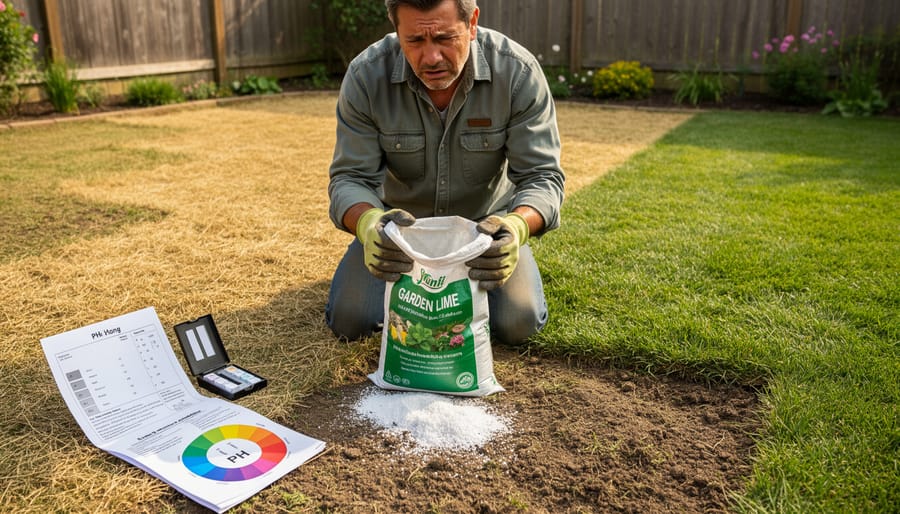
Think of buffer pH as your soil’s memory or stubbornness factor. While regular pH tells you where your soil stands today, buffer pH reveals how hard your soil will fight to stay that way.
Here’s what makes this measurement so valuable: some soils are like easygoing friends who readily accept change, while others are set in their ways and resist every adjustment you try to make. Buffer pH quantifies exactly how resistant your soil is to pH changes, which directly translates to how much lime or sulfur you’ll actually need to achieve your target pH.
When you receive a soil test with both measurements, the buffer pH acts as your amendment calculator. It accounts for your soil’s natural buffering capacity, which comes primarily from organic matter, clay content, and mineral composition. Sandy soils typically have low buffering capacity and require less amendment, while clay-rich soils packed with organic matter have high buffering capacity and need substantially more.
This is why buffer pH is your best friend when shopping for amendments. Without it, you’d be guessing at quantities, potentially under-treating stubborn soils or over-treating cooperative ones. The buffer pH reading essentially answers the question: “Okay, I know where my pH is now, but how much work will it take to get it where I need it?”
Most soil test reports use buffer pH to generate specific amendment recommendations measured in pounds per hundred square feet, taking all the guesswork out of the equation for you.
How Buffer pH Testing Works
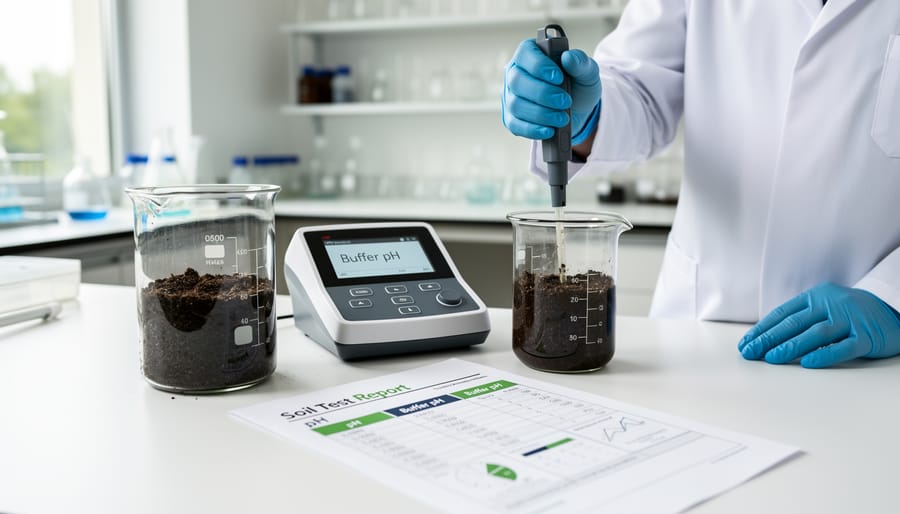
Think of buffer pH testing as a way to measure your soil’s stubbornness when it comes to pH changes. Here’s what happens in the lab: after determining your regular soil pH, technicians add a special buffer solution (usually a mixture of chemicals with a known pH around 7.5 or 8.0) to your soil sample. This solution essentially challenges your soil, trying to push the pH higher.
The resulting buffer pH number reveals how much your soil resisted that change. If your soil has high buffering capacity, it fights back hard against the buffer solution, resulting in a lower buffer pH reading. This tells us you’ll need more lime to adjust the pH. If the soil has low buffering capacity, the buffer solution easily shifts the pH higher, giving you a buffer pH reading closer to the solution’s original pH.
Labs typically perform this test only when your initial soil pH reads acidic, usually below 7.0. Why? Because that’s when you’re most likely considering adding lime to raise the pH, and the buffer pH calculation directly informs how much lime you’ll need. For neutral or alkaline soils above 7.0, this test isn’t necessary since you wouldn’t be adding lime anyway.
The Numbers That Matter
Understanding how soil pH and buffer pH work together is like having two pieces of a puzzle. Your regular soil pH tells you where you are right now, while buffer pH reveals how much lime you’ll actually need to get where you want to be.
Let’s say your soil test shows a pH of 5.5 with a buffer pH of 6.2. That buffer reading indicates relatively light buffering capacity, meaning your soil won’t fight change too hard. You might need around 3 pounds of lime per 100 square feet to raise it to 6.5.
Now imagine another scenario: same 5.5 pH, but with a buffer pH of 7.0. This higher buffer reading signals heavy buffering, like dense clay soils rich in organic matter. Here, you’d need considerably more lime, perhaps 6-8 pounds per 100 square feet, to achieve that same 6.5 target.
Think of buffer pH as your soil’s resistance level. The wider the gap between your current pH and buffer pH, the less amendment you’ll need. When they’re closer together, your soil has more buffering power and requires stronger intervention.
Your soil test report should include specific lime recommendations based on both numbers combined, giving you the exact amounts for your unique situation.
When You Need Buffer pH (And When You Don’t)
Here’s the thing about buffer pH testing: it’s incredibly useful, but not everyone needs it every time. Let me help you figure out when it’s worth the extra investment.
If you’re working with sandy soils, you can typically skip buffer pH testing. These soils have naturally low buffering capacity, so your standard pH reading tells you most of what you need to know. A simple application of lime or sulfur usually does the trick without complicated calculations.
However, buffer pH becomes your best friend when dealing with clay-heavy or high-organic-matter soils. These soils resist pH changes stubbornly, and buffer pH tells you exactly how much amendment you’ll need. I learned this the hard way after repeatedly under-liming my garden’s clay beds—those soil particles were holding onto acidity like nobody’s business!
You absolutely want buffer pH information if you’re growing acid-loving plants like blueberries or rhododendrons. The precision matters here because these plants are finicky about their soil conditions. Similarly, if you’re establishing a new garden bed or lawn where you’ll be making significant pH adjustments, buffer pH helps you avoid the costly mistake of applying too little or too much amendment.
For vegetable gardens with reasonably balanced soil, annual standard pH tests usually suffice. But when that first test reveals you’re far from your target pH range, spring for the buffer pH test before buying amendments in bulk. It’s like getting a detailed map before a long journey—you’ll save time, money, and frustration knowing exactly where you’re headed.
Putting Both Numbers to Work in Your Garden
Now that you understand the difference between pH and buffer pH, let’s put this knowledge to work! Think of these two numbers as your gardening GPS—together, they’ll guide you to exactly how much amendment your soil needs.
Start by grabbing your soil test results and locating both measurements. If your current pH is already within your target range, congratulations—you can skip amendments this season! But if you need to make changes, here’s where buffer pH becomes your best friend.
For acidic soils needing lime, your buffer pH tells you how much limestone to apply. Most soil test reports include a conversion chart that matches buffer pH readings to pounds of lime per 1,000 square feet. A lower buffer pH means your soil has less resistance to change, so you’ll need less lime. Conversely, a higher buffer pH indicates stronger resistance, requiring more amendment.
Let me share what I learned from Master Gardener Patricia Chen, who’s been testing soils for twenty years: “I always tell gardeners to trust the buffer pH calculation over guesswork. I’ve seen people over-lime their gardens by just eyeballing it, and that creates problems that take years to fix.”
For alkaline soils needing sulfur, the process works similarly but in reverse. Your buffer pH helps determine how much elemental sulfur or aluminum sulfate you’ll need. The buffer reading accounts for your soil’s limestone content and clay percentage—factors that dramatically affect how quickly amendments work.
Here’s a practical tip: never apply all the recommended amendment at once if the calculation suggests more than fifty pounds per 1,000 square feet. Split applications over two or three seasons, retesting annually. This prevents shocking your plants and gives you better control over the results.
Remember, adjusting pH for specific plants requires patience and precision. Whether you’re lowering soil pH safely or raising it gradually, those two numbers working together will get you there successfully.
Getting Your Soil Tested the Right Way
Getting accurate soil test results starts with choosing the right testing service. Your local university extension office typically offers comprehensive testing that includes both pH and buffer pH measurements at affordable prices, usually between $10-25 per sample. Private labs are another option, though they can be pricier. When selecting a service, confirm they specifically measure buffer pH, as some basic tests only report standard pH.
Taking proper samples makes all the difference in getting useful results. Collect soil from multiple spots in your testing area, digging down about 6 inches after removing any surface debris. Mix these samples together in a clean bucket to create one representative sample. Avoid contamination by using clean tools and keeping samples away from galvanized containers or fertilizer residue.
I learned this lesson the hard way when my first test came back wildly inaccurate because I’d used a rusty old coffee can. Live and learn!
When your results arrive, you’ll see both pH and buffer pH numbers along with lime recommendations if needed. Don’t panic if the numbers seem confusing at first. The lab typically provides interpretation guidelines explaining what actions to take based on your specific soil type and the plants you’re growing.
How often should you test? For established gardens, every 2-3 years works well, though new gardens or those undergoing major amendments benefit from annual testing. If you’re actively working to adjust pH, test yearly to track your progress. The small investment pays off tremendously in healthier plants and better harvests.
Real Garden Success Stories
Maria from Michigan spent three years wondering why her blueberries never thrived, despite religiously adding sulfur to lower her soil pH. When she finally got a buffer pH test, everything clicked. Her soil’s buffer pH revealed it had massive resistance to change—she needed far more sulfur than the basic pH reading suggested. Within one growing season of following the buffer pH recommendations, her bushes doubled in size and produced their first abundant harvest.
Then there’s David, whose vegetable garden struggled with stunted growth despite what seemed like perfect pH levels. His buffer pH test showed his sandy soil had very low buffering capacity, meaning nutrients were washing away quickly with each watering. He started adding compost to increase the buffer capacity, and his tomatoes and peppers finally took off.
These stories remind us that understanding buffer pH isn’t just about numbers—it’s about giving your plants exactly what they need to flourish. Sometimes that missing piece of information makes all the difference.
You’ve now got a solid understanding of both soil pH and buffer pH—and that’s something to celebrate! Think of yourself as having unlocked a secret level in your gardening journey. By knowing the difference between these two measurements, you’re equipped to make smarter decisions about lime applications, saving yourself time, money, and the frustration of guessing how much amendment your soil truly needs.
Remember, soil pH tells you where you are right now, while buffer pH reveals how much effort it’ll take to get where you want to be. Together, they’re your dynamic duo for soil success. Instead of applying lime based on rough estimates or outdated advice, you can work with precision and confidence.
Ready to put this knowledge into action? When you send off your next soil sample, make sure to request a buffer pH test alongside the standard pH reading. That small addition to your test will provide the complete picture you need to transform your soil and watch your garden thrive like never before.