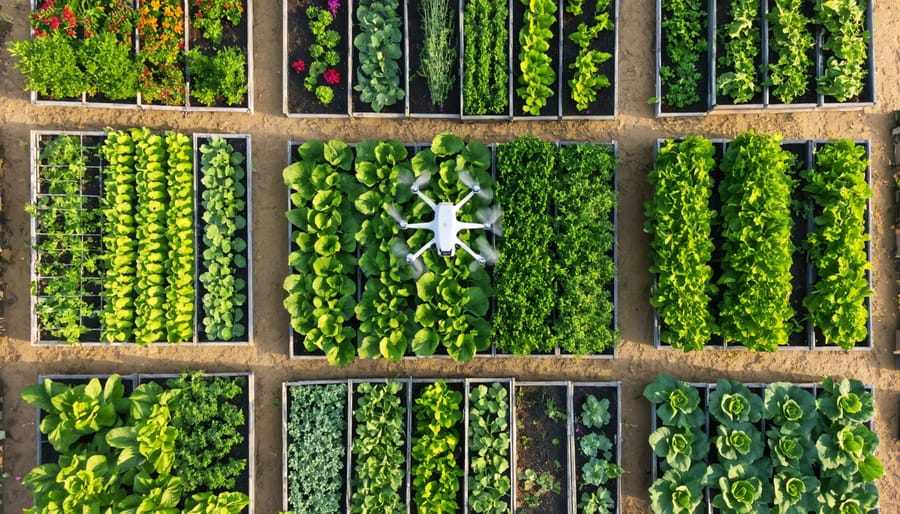
Picture yourself hovering 50 feet above your garden, capturing a bird’s-eye view that reveals patterns invisible from ground level: water-stressed plants showing up as darker patches, pest infestations clustered in specific zones, and uneven fertilizer distribution creating striped growth patterns. This isn’t science fiction or reserved for commercial farms. Drone technology has become surprisingly accessible for home gardeners, with capable models starting under $300 and smartphone apps that transform aerial footage into actionable garden insights.
The transformation happens quickly. Within minutes of your first flight, you’ll spot drainage problems you’ve walked past for years, identify which sections of your vegetable patch need attention, and create a visual record that helps track seasonal changes. You’re not replacing your hands-in-the-soil connection to gardening; you’re gaining a powerful new perspective that makes every garden decision smarter.
Whether you’re managing a modest backyard plot or tending several garden beds, drones offer practical benefits that justify the learning curve. You’ll monitor plant health without disturbing delicate seedlings, assess frost damage across your entire property in one flight, and catch problems early when they’re easiest to fix. The technology sounds intimidating, but most gardeners fly confidently within their first week, discovering that modern drones are as user-friendly as the smartphone already in your pocket.
What Is Drone-Assisted Garden Monitoring?

The Technology Behind Garden Drones (Made Simple)
Think of garden drones as flying cameras with helpful extras. At their heart, they’re equipped with high-quality cameras that capture detailed images of your garden from above, giving you a bird’s-eye view you simply can’t get from ground level. These cameras work much like your smartphone camera, but they’re designed to spot things that matter to plants, like color changes in leaves that might indicate stress or disease.
Beyond cameras, many garden drones carry sensors that measure what your eyes can’t see. Some detect moisture levels across your lawn, helping you identify dry spots before they turn brown. Others measure temperature variations that reveal which areas of your garden get too hot or stay too cool. This information becomes part of your garden automation technology toolkit, making plant care more precise and less guesswork.
The flight capability itself is surprisingly straightforward. Modern garden drones use GPS to hover steadily and follow pre-planned routes over your garden. Many can be controlled with a smartphone app, flying themselves along paths you’ve set up. They return automatically when their battery runs low, typically after 20-30 minutes of flight time.
What makes this technology genuinely useful for gardeners is how it translates technical data into actionable insights. Instead of confusing readouts, you’ll see color-coded maps showing exactly where your garden needs attention, making it easy to decide where to water, fertilize, or investigate potential problems.
Why Your Garden Might Need a Drone’s Eye View
Spotting Plant Stress Before It Becomes a Crisis
Have you ever walked through your garden thinking everything looked fine, only to discover a pest infestation or disease had already spread? It happens to all of us. The challenge is that at ground level, we can only see what’s directly in front of us. A few yellowing leaves here or some discoloration there might seem insignificant, but from above, these scattered warning signs often reveal a troubling pattern.
This is where drones truly shine. When you fly over your garden beds, subtle color changes become obvious. That slight wilting in your tomato patch? From the air, you’ll notice it’s affecting an entire row, not just the two plants you spotted yesterday. Brown patches in your lawn that seemed random suddenly form a clear path indicating grub damage or fungal spread.
I learned this firsthand when I borrowed a neighbor’s drone last summer. What I thought was isolated aphid damage on a few roses turned out to be a widespread problem affecting my entire hedge. The aerial footage revealed the telltale yellowing pattern I’d completely missed during my daily garden walks. Combined with AI plant disease detection, this early warning system lets you intervene before minor issues become major headaches, saving both plants and money.

Tracking Growth Patterns Over Time
One of the most rewarding aspects of drone monitoring is watching your garden transform before your eyes through a visual timeline. By taking aerial photos every few weeks throughout the growing season, you create a fascinating record of how your plants develop, spread, and respond to your care.
Think of it as a growth diary that reveals patterns you might miss from ground level. That shady corner you thought was thriving? Monthly drone photos might show it’s actually growing more slowly than sunnier spots. Those companion plantings you experimented with? Your aerial timeline can demonstrate whether they truly helped or hindered each other.
I’ve found that reviewing photos side-by-side at season’s end is incredibly instructive. You’ll notice which vegetables outperformed expectations, where weeds consistently appear first, and how your watering patterns affected different areas. This insight becomes your roadmap for next season’s planning.
Many gardeners I’ve spoken with say their drone timeline helped them identify problems early, spot successful combinations worth repeating, and gain confidence in their decision-making. It’s like having a mentor showing you exactly what worked and what didn’t, except the mentor is your own garden speaking through images.
Managing Water Distribution More Effectively
Water is one of those resources where more isn’t always better, and here’s where drones really shine in helping you get it just right. From ground level, your garden might look uniformly green, but a drone’s aerial perspective tells a completely different story. Those thermal and multispectral cameras we talked about earlier can detect moisture levels across your entire garden, revealing patterns you’d never spot from your usual vantage point.
Think of it like having x-ray vision for your soil. Overwatered spots show up as cooler, darker areas in thermal imagery, while dry patches appear warmer. This is incredibly valuable because overwatering doesn’t just waste water—it can lead to root rot and fungal problems, while dry spots stress your plants unnecessarily.
When you pair drone monitoring with smart irrigation systems, you’re creating a powerful combination for sustainable water management. The drone data shows you exactly where adjustments are needed, allowing you to fine-tune your watering zones or identify issues like clogged drip lines or poorly positioned sprinklers.
I recently spoke with Maria Chen, a landscape designer in California, who discovered her supposedly drought-tolerant garden had three surprisingly soggy zones. After drone mapping revealed the problem areas, she adjusted her irrigation schedule and cut her water usage by thirty percent while actually improving plant health.
Planning and Redesigning with Confidence
Have you ever wished you could see your garden the way a bird does? That overhead perspective changes everything! When you capture aerial footage of your garden, you suddenly see patterns and possibilities you’ve been missing from ground level.
I remember chatting with landscape designer Maria Chen, who told me she now starts every project with drone imagery. “You can spot where shade falls throughout the day, identify awkward gaps between beds, and visualize how new features will fit into the existing space,” she explained. It’s like having x-ray vision for your garden layout.
This bird’s-eye view is invaluable when planning expansions or redesigning tired areas. You’ll notice which paths get the most wear, where water pools after rain, and how your plantings relate to each other spatially. Maybe that vegetable bed you’re planning would work better ten feet to the left, or perhaps there’s room for that greenhouse you’ve been dreaming about.
Pair your drone images with AR garden planning tools for even more design power. Print out your aerial photos, sketch ideas directly on them, or upload them to planning software. This confident, informed approach means fewer costly mistakes and better results from day one.

Getting Started: Choosing Your Garden Monitoring Drone
Features That Actually Matter for Gardeners
When shopping for a garden monitoring drone, you don’t need the fanciest model on the market. Let me walk you through what really matters for keeping an eye on your plants.
Camera quality is your top priority. Look for at least 1080p resolution, which gives you clear enough images to spot pest damage, nutrient deficiencies, and growth patterns. While 4K sounds impressive, it’s overkill for most garden applications and dramatically increases cost. A decent 12-megapixel camera will serve you beautifully.
Flight time matters more than you might think. Budget drones often fly for just 10-15 minutes, which barely covers a large garden. Aim for models offering 20-25 minutes of flight time. This gives you enough wiggle room to capture what you need without constantly swapping batteries mid-survey.
For ease of use, prioritize drones with automatic stabilization and one-button takeoff and landing. Trust me, you’ll appreciate these features when you’re learning. GPS hold features are fantastic too, letting the drone hover steadily while you focus on observation rather than frantic piloting.
What you don’t need? Obstacle avoidance systems add hundreds to the price but aren’t essential in open garden spaces. Follow-me modes and gesture controls sound fun but rarely prove useful for monitoring plants. Advanced racing features? Definitely skip those.
Battery life indicators and mobile app connectivity are genuinely helpful, letting you plan your monitoring sessions effectively. Most mid-range drones include these as standard features, making them the sweet spot for gardeners.
Budget-Friendly Options to Consider
Good news for budget-conscious gardeners: you don’t need to spend a fortune to start monitoring your garden from above! Entry-level drones with cameras typically range from $100 to $300 and work wonderfully for basic garden surveillance. These starter models can capture high-quality photos and videos, helping you spot irrigation issues, track plant growth, and identify pest problems before they spread.
Mid-range options between $300 and $800 offer enhanced features like better camera resolution, longer flight times, and obstacle avoidance sensors that make them easier to fly around trees and structures. These are excellent choices if you’re managing a larger property or want more detailed plant health data.
For most home gardeners, honestly, a basic model is entirely sufficient. I’ve spoken with experienced gardeners who’ve achieved impressive results using affordable starter drones, particularly for capturing time-lapse growth sequences and identifying drainage problems across their property. The key is starting simple, learning the basics, and upgrading only when you’ve identified specific features you truly need. Remember, even basic drones provide a perspective you simply can’t get from ground level, making them valuable tools regardless of price point.
What You Need to Know About Regulations
Before you launch your drone to survey your garden, it’s worth knowing a few basic guidelines to keep your flights legal and safe. In most areas, recreational drone use requires registration if your device weighs over 0.55 pounds, which costs around $5 and takes just minutes online. The good news? You don’t need a commercial license for personal garden monitoring.
Keep your drone below 400 feet, maintain visual line of sight, and avoid flying over neighbors’ properties without permission. Most residential drones stay well within these limits naturally. If you’re planning to share aerial photos on social media or YouTube, you’re still fine under recreational rules as long as you’re not getting paid for the content.
Think of these regulations as helpful guardrails rather than obstacles. They protect everyone’s privacy and safety while letting you explore this exciting technology freely. When in doubt, a quick chat with your local drone community or online forum can clear up questions specific to your area.
Practical Ways to Monitor Your Garden with a Drone
Creating a Regular Monitoring Schedule
Setting up a regular monitoring schedule doesn’t need to be complicated. I’ve found that flying my drone every two weeks works beautifully for keeping tabs on how my garden evolves. If you’re just starting out, aim for weekly flights during the growing season when changes happen quickly, then shift to bi-weekly checks during slower periods.
Timing matters more than you might think. Early morning flights, about an hour after sunrise, give you the clearest views before heat haze sets in, and plants show stress signals more visibly when they’re still transpiring actively. Late afternoon works too, especially in summer when you want to capture irrigation patterns.
What you’re looking for changes with the seasons. Spring flights help you track germination rates and identify bare spots needing attention. Summer monitoring focuses on moisture stress, pest outbreaks, and crop health using those color variations we discussed earlier. Fall flights reveal which areas need soil amendment, while winter checks help you plan next season’s layout.
Keep a simple flight log noting weather conditions, what you observed, and any follow-up actions needed. After a few flights, you’ll develop an eye for what’s normal in your garden and spot problems before they become serious.
Reading Your Garden from Above
Learning to read your garden from above is like gaining superpowers for your green space! When you first look at drone photos, you might see a beautiful bird’s-eye view, but there’s so much more information hiding in those images once you know what to look for.
Start by examining color variations across your garden beds. Healthy plants show rich, uniform greens, while stressed areas appear lighter or yellowed. I remember when master gardener Janet Rodriguez first showed me her drone photos—she pointed out a subtle pale patch I’d never noticed from ground level, which turned out to be a drainage issue causing root stress.
Look for patterns that reveal hidden problems. Dark spots might indicate overwatering or disease clusters, while brown patches could signal pest infestations or nutrient deficiencies. These patterns often spread in predictable ways—circular for fungal issues, linear along irrigation lines for water problems.
Pay attention to plant density and growth rates too. Areas where plants seem stunted compared to their neighbors often point to soil compaction or pH imbalances. Combining aerial imaging with smart soil testing technology gives you the complete picture.
Don’t worry if this feels overwhelming initially. Start by comparing photos taken weekly, noting obvious changes first. Your eye will naturally develop over time, and soon you’ll spot issues before they become serious problems, saving both plants and money.
Documenting and Comparing Over Time
The real magic happens when you compare images from different weeks or months. I organize my drone photos by date in simple folders on my computer—nothing fancy needed! Create subfolders like “May-2024” or “Week-of-June-10” so you can easily find what you’re looking for later.
To create side-by-side comparison images, try free tools like GIMP (a powerful photo editor) or even Canva’s free version. Simply upload two photos from different dates, place them next to each other, and add the dates as labels. You’ll be amazed at how clearly you can see changes in plant growth, soil moisture, or even pest damage spreading.
I keep a simple spreadsheet noting the date, weather conditions, and any observations for each flight. This becomes invaluable when you’re trying to figure out why your tomatoes suddenly thrived in July or what caused that brown patch in August. Some gardeners I’ve interviewed swear by free apps like Google Photos for automatic organization by date, making it effortless to scroll back through time and spot patterns you might have missed while viewing single images.
Real Gardeners, Real Results: A Conversation About Drone Monitoring
I sat down with Maria Chen, an avid gardener from Portland, Oregon, who started using a basic drone in her half-acre vegetable and flower garden last spring. Her journey from skeptic to enthusiast offers valuable insights for anyone considering this technology.
“I’ll be honest, I thought drones were just fancy toys,” Maria admits with a laugh. “My husband suggested it after seeing a neighbor use one, and I was convinced it was overkill for our modest garden. But curiosity got the better of me.”
Maria started with an affordable consumer drone equipped with a basic camera, spending around $300. Her first flights were shaky, literally. “I nearly crashed it into our apple tree twice that first week! But once I got comfortable with the controls, something clicked. I could suddenly see patterns I’d been missing from ground level.”
Her biggest discovery came three weeks in. The drone footage revealed that a section of her tomato plants showed slightly different coloring. “From the ground, everything looked fine, but the aerial view made it obvious something was off. Turns out, that area had a drainage problem I’d completely missed. We fixed it before it became a serious issue.”
When asked about practical tips for beginners, Maria emphasizes starting simple. “Don’t worry about fancy sensors at first. Just learn to fly safely and take regular photos. I fly the same route every Sunday morning when the light is good. Consistency helps you spot changes faster.”
Her advice for hesitant gardeners is reassuring: “You don’t need to be tech-savvy. If you can use a smartphone, you can fly a basic drone. The key is giving yourself permission to learn gradually.”
What surprised Maria most was how the drone changed her relationship with her garden. “I thought it would make gardening feel more technical, but it actually deepened my appreciation. Seeing your garden from above is like discovering a living piece of art you created. It’s genuinely magical.”
Common Concerns (And Why They Shouldn’t Stop You)
“I’m Not Tech-Savvy Enough”
I completely understand this concern—I felt the same way before trying my first drone! Here’s the good news: today’s garden drones are designed with beginners in mind. Most models feature one-button takeoff and landing, automatic hovering that keeps them steady even in light wind, and smartphone apps with intuitive interfaces that feel as simple as using your favorite social media platform.
Many drones now include automated flight paths, meaning you can literally draw a route on your phone screen and watch the drone follow it independently while capturing images of your garden beds. No piloting skills required! I interviewed several gardeners who’d never touched a gaming controller, yet they were confidently flying drones within their first afternoon of practice. Start with budget-friendly models that include built-in safety features like obstacle detection and automatic return-home functions. These smart features act like training wheels, giving you confidence while you learn. Think of it as upgrading from hand-weeding to using a hoe—just a new tool that makes your gardening easier once you give it a chance.
“My Garden Isn’t Big Enough to Justify a Drone”
You might be surprised at how useful a drone can be, even in a modest backyard garden. Think of it this way: when was the last time you got a clear look at your gutters or noticed exactly where water pools after a rain? A drone offers you a completely fresh perspective that’s simply impossible from ground level.
For smaller gardens, drones excel at detailed inspection tasks. You can spot pest damage on fruit trees before it spreads, identify drainage issues that aren’t obvious from below, or check whether your climbing plants need support in hard-to-reach spots. I spoke with Sarah Chen, an urban gardener in Seattle, who discovered her raised beds were getting uneven sun exposure by reviewing simple drone footage. A quick adjustment doubled her tomato harvest.
Beyond practical monitoring, there’s something genuinely special about documenting your garden’s transformation through the seasons from above. These bird’s-eye images capture your hard work in ways that ground-level photos simply can’t match, creating beautiful records you’ll treasure for years.
“What About My Neighbors’ Privacy?”
Being a considerate drone operator helps everyone enjoy their outdoor spaces. Before flying over your garden, give your neighbors a friendly heads-up about what you’re doing. A quick chat explaining you’re monitoring your plants can prevent misunderstandings and might even spark their curiosity!
Keep flights brief and purposeful rather than hovering endlessly. Early morning sessions work wonderfully—you’ll capture the best garden lighting while most folks are still inside. Stay focused on your own property, and angle your camera downward toward your plants rather than sideways toward neighboring yards.
If you live in a densely populated area, consider a smaller, quieter drone model that’s less intrusive. Some gardeners I’ve spoken with schedule their flights when neighbors are at work or coordinate with them for mutually convenient times. Remember, respecting privacy builds community goodwill and might just earn you some enthusiastic supporters for your gardening adventures. Your consideration today creates a friendlier environment for all drone-using gardeners tomorrow.
Beyond Monitoring: Creative Ways to Use Your Garden Drone
Once you’ve gotten comfortable with monitoring your garden from above, the creative possibilities really open up! Your drone isn’t just a practical tool—it’s also a fantastic way to document and celebrate your gardening journey.
Time-lapse photography is one of the most rewarding drone applications. Set up regular flights over the same area throughout the growing season, and you’ll capture the incredible transformation of your garden from bare soil to lush abundance. These videos make wonderful keepsakes and never fail to amaze when you look back at how much your plants have grown. I particularly love capturing the progression of my sunflower patch—from tiny seedlings to towering blooms reaching for the sky.
Garden progress documentation becomes effortless with aerial photography. Share bird’s-eye views of your vegetable beds on social media, and watch your gardening friends marvel at the organization and beauty of your space. These photos offer a perspective we rarely see and can inspire others in their own gardening adventures.
Creating a visual garden journal takes on new meaning with drone footage. Traditional journals are wonderful, but adding aerial shots gives you context that ground-level photos simply can’t match. You’ll see patterns in your planting, identify areas that need attention, and track which companion planting arrangements work best—all while building a stunning visual record of your efforts.
Some gardeners even use their drones for creative projects like mapping their property for future garden expansions or creating personalized greeting cards featuring aerial shots of their prize-winning dahlias. The key is letting your imagination guide you. Your garden is a canvas, and your drone helps you see it from an entirely new artistic perspective.
If you’ve been curious about using drones for garden monitoring but felt uncertain about taking the plunge, here’s the truth: you don’t need to become an expert overnight. Start small. Perhaps begin by borrowing a friend’s drone for an afternoon, or invest in a basic model to capture simple overhead photos of your garden layout. You’ll be surprised how quickly you’ll spot patterns and opportunities you’ve been missing from ground level.
The beauty of this technology is that it grows with you. Your first flight might simply reveal where water pools in your yard. Six months later, you might be tracking plant growth rates and identifying pest hotspots before they become problems. There’s no pressure to master everything at once, and the learning process itself is genuinely enjoyable.
Remember, drones aren’t just for tech enthusiasts or commercial farmers anymore. They’re practical tools that everyday gardeners are using to make smarter decisions, save time, and nurture healthier gardens. You already care deeply about your plants and outdoor spaces. A drone simply gives you a new perspective on what you already love.
So why not give it a try? Start with one simple goal, take that first flight, and see what you discover. And when you do, we’d love to hear about it. Share your experiences, your photos, and your lessons learned with our community. Together, we’re proving that the future of gardening is accessible to everyone.