Plant low-growing spring bulbs like crocuses and daffodils at the base of your hollyhocks in fall, giving you vibrant color during the months before your hollyhocks emerge and claim their vertical space. This layering strategy transforms what would be bare ground into productive garden real estate while the hollyhock crown remains dormant.
Surround emerging hollyhock seedlings with quick-maturing lettuce, radishes, or spinach in early spring, harvesting these crops completely before hollyhocks develop their full leaf canopy in late May. This succession approach maximizes soil nutrients and garden space during the hollyhocks’ slow early growth phase.
Pair mature hollyhocks with mid-height summer bloomers like catmint, salvia, or coreopsis planted 18-24 inches away from the main stalk. These companions disguise hollyhocks’ tendency toward bare lower stems while benefiting from the afternoon shade cast by those towering flower spikes, especially in hot climates where both plants thrive.
Interplant fall-blooming asters or sedums between second-year hollyhocks in June, allowing these perennials to establish roots while hollyhocks dominate the show. When your biennials complete their lifecycle and need removal in autumn, these proven companion plant combinations seamlessly take over, maintaining visual interest through frost.
Mark locations where you’ve removed spent hollyhocks and immediately plant garlic cloves or other fall crops in those gaps, preventing weeds from colonizing vacant spots while your self-sown hollyhock seedlings establish nearby for next year’s display.
Why Hollyhocks Are Perfect for Seasonal Succession Planning
If you’ve ever watched your spring garden fade into a sea of green by July, hollyhocks might be exactly what you need to bridge that awkward summer gap. These towering beauties have a built-in calendar that works perfectly with the rhythm of perennial borders, taking center stage just as your early bloomers bow out.
Most hollyhocks are biennials, which means they follow a two-year growth cycle. In their first year, they develop a robust rosette of leaves close to the ground, building strength and establishing roots. It’s in their second year that the magic happens, when they send up those magnificent flower spikes reaching 5 to 8 feet tall. These spires burst into bloom from midsummer through early fall, offering continuous color for up to eight weeks or more.
This predictable timing makes hollyhocks natural companions for succession planning. While your tulips, daffodils, and peonies perform their spring show, young hollyhock rosettes quietly grow at ground level, barely noticeable beneath the action. By the time those spring stars have finished and your garden feels a bit tired, hollyhocks are ready to shoot skyward and steal the spotlight.
Master gardener Patricia Henderson, whom I interviewed at her Massachusetts cottage garden, puts it beautifully: “Hollyhocks are like patient understudies waiting in the wings. They don’t compete with spring’s drama, but when summer arrives, they’re perfectly positioned to become the main attraction.”
The key to working with their biennial nature is staggered planting. Start new hollyhock plants every year, and you’ll maintain continuous blooms rather than experiencing boom-and-bust cycles. Many varieties self-sow readily too, creating their own succession without any effort from you. This means establishing just one generation can lead to reliable vertical interest year after year, though you may want to thin seedlings to control placement and prevent overcrowding.
Spring Companions: What to Plant With Early-Season Hollyhocks
Low-Growing Spring Bulbs and Hollyhock Roots
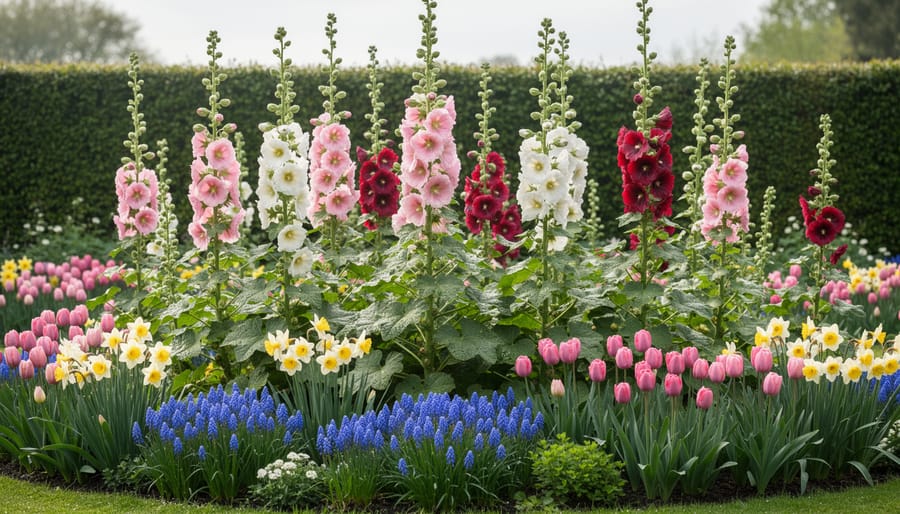
Spring-flowering bulbs make wonderful companions at the base of your hollyhocks, offering cheerful early-season color while your statuesque plants are just emerging. Since hollyhocks take their time establishing in spring, low-growing bulbs fill that bare space beautifully without competing for resources.
Daffodils are my top recommendation for hollyhock companions. Their early bloom time means they’ve finished flowering and started going dormant right when hollyhocks begin their vigorous growth phase. Plant them 6-8 inches away from where you’ve sown your hollyhock roots to give both plants breathing room. Tulips work similarly well, though they tend to be a bit pickier about drainage.
Crocuses are perfect if you’re working with smaller spaces. These tiny powerhouses pop up in late winter, providing that first splash of color we all crave after a long cold season. They naturalize easily and won’t interfere with your hollyhocks’ root systems.
I recently chatted with Ellen Martinez, a master gardener in Vermont, who plants grape hyacinths around her hollyhocks. “The blue against those pink and white hollyhocks come summer creates magic,” she told me. “Plus, the bulb foliage dies back before the hollyhocks need full stage presence.”
Cool-Season Vegetables That Finish Before Hollyhocks Peak
One of my favorite strategies for maximizing garden space around hollyhocks is planting cool-season vegetables that finish their growing cycle well before those magnificent stalks claim their full territory. Since hollyhocks really shoot up and spread out by mid-summer, you’ve got a perfect window for early spring crops.
Lettuce is an ideal companion for young hollyhocks. Plant loose-leaf varieties like ‘Black Seeded Simpson’ or ‘Oak Leaf’ in March or early April, about 12 inches away from where your hollyhock rosettes are forming. You’ll harvest your lettuce by late May or early June, just as your hollyhocks begin their upward stretch. The lettuce actually benefits from the light shade cast by developing hollyhock foliage during those unexpectedly warm spring days.
Peas work beautifully too, especially bush varieties that don’t need extensive support. I chatted with master gardener Susan Chen from Portland, who swears by planting ‘Sugar Ann’ snap peas around her hollyhock border each March. “They’re done by the Fourth of July,” she told me, “right when my hollyhocks are starting their flower show.”
Spinach is another quick finisher. Direct seed it in early spring around your hollyhock bases, and you’ll enjoy multiple harvests before summer heat arrives. The key is timing your planting to coincide with the last frost date in your area, giving these cool-season crops a solid two to three months before your hollyhocks demand center stage.
Summer Partners: Plants That Bloom Alongside Hollyhock Towers
Shade-Tolerant Plants for the Hollyhock Base
As your hollyhocks reach their impressive heights, they naturally create pockets of dappled shade at their base. This microclimate becomes the perfect home for plants that appreciate some relief from intense sun. Think of it as your hollyhocks giving back to the garden community!
Hostas are my go-to choice for filling this shaded space. Their broad, textured leaves create wonderful contrast against hollyhock stems, and they’re incredibly low-maintenance. I’ve found that blue-green varieties like ‘Halcyon’ look especially striking paired with pink or white hollyhocks.
Astilbes bring graceful, feathery plumes that bloom in early to midsummer, just before your hollyhocks steal the show. Their preference for partial shade and consistent moisture makes them ideal companions, and the layered look of astilbe blooms beneath towering hollyhocks adds wonderful depth to borders.
Don’t overlook ferns for this shaded real estate. Japanese painted ferns or lady ferns provide elegant, lacy foliage that stays attractive all season long. They’re practically carefree once established and help suppress weeds around your hollyhock bases. This combination creates a cottage garden feel that looks intentional rather than overcrowded, maximizing every inch of your planting space.
Mid-Height Bloomers That Create Stunning Layers
Creating visual depth in your garden becomes wonderfully easy when you pair hollyhocks with mid-height bloomers that perform during the same summer window. These companions fill that crucial middle layer between your towering hollyhocks and ground-hugging plants.
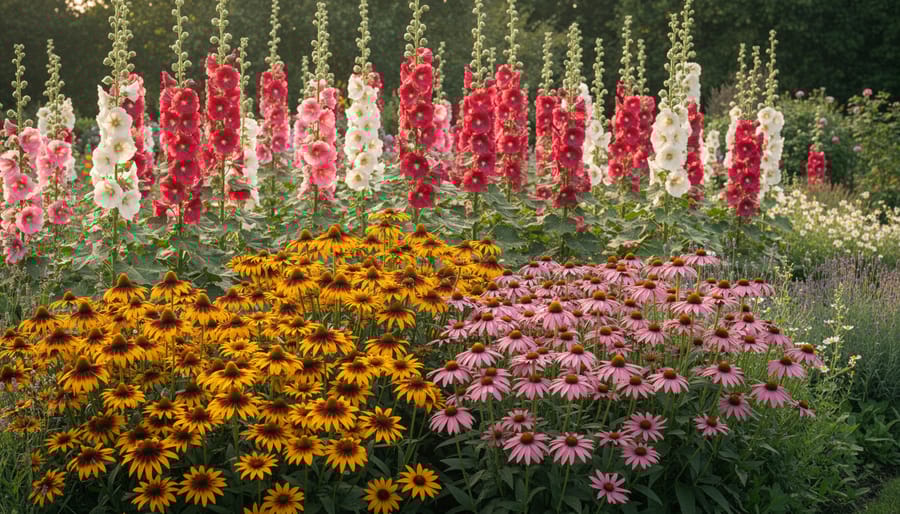
Purple coneflowers (Echinacea) are perhaps the most reliable choice, reaching 2-3 feet tall and blooming from early to late summer. Their daisy-like flowers and drought tolerance make them perfect coneflowers as companions for hollyhocks. I’ve watched goldfinches feast on coneflower seedheads right next to my hollyhocks, creating a lovely wildlife spectacle.
Black-eyed Susans (Rudbeckia) bring cheerful golden blooms at similar heights, typically 18-30 inches. They’re practically carefree once established and share hollyhocks’ preference for full sun. Plant them about 18 inches in front of your hollyhocks for maximum impact.
Daylilies offer another fantastic option, especially reblooming varieties that extend the show. Their strap-like foliage provides textural contrast to hollyhock leaves, and their 24-36 inch height creates that dimensional quality experienced gardeners seek. Choose varieties that bloom mid-summer to synchronize with your hollyhocks’ peak performance.
Pollinator-Friendly Herbs That Love Hollyhock Neighbors
Herbs make wonderful neighbors for hollyhocks, attracting beneficial pollinators while keeping garden pests at bay. When you’re exploring herb companion planting, consider tucking basil around the base of your hollyhocks. This fragrant herb thrives in the same sunny conditions and draws helpful insects like bees and butterflies to your garden.
Oregano creates a lovely low-growing carpet beneath tall hollyhock stalks, its tiny flowers buzzing with pollinators throughout summer. I’ve found it particularly useful for filling gaps while young hollyhocks establish themselves during their first season.
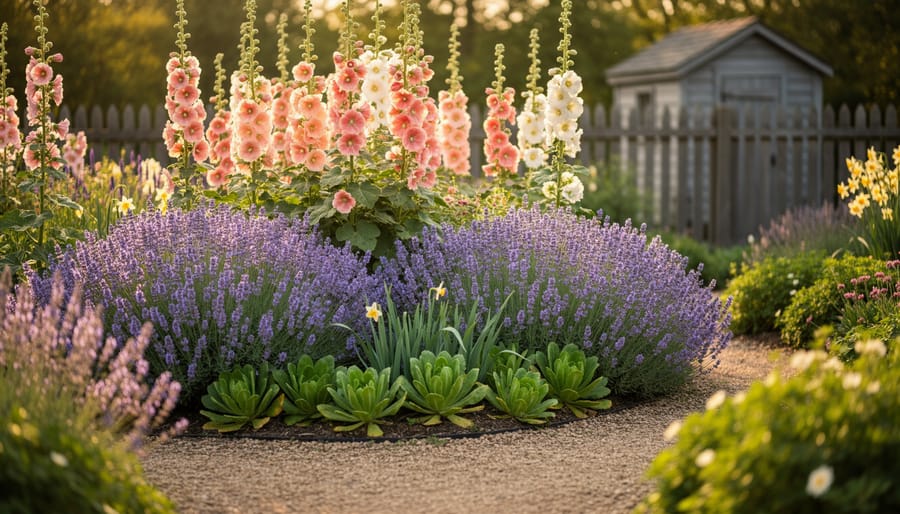
Lavender pairs beautifully with hollyhocks, offering silver-green foliage that complements those cottage-garden blooms. Plant it about 18 inches away to give both plants breathing room. Master gardener Susan Lee notes that this combination creates a “pollinator highway” in her garden, with beneficial insects moving freely between the purple lavender spikes and colorful hollyhock towers, maximizing productivity across the entire planting area.
Fall Succession: Filling the Gap When Hollyhocks Fade
Late-Blooming Perennials to Extend the Show
As your hollyhocks begin their natural decline in late summer, it’s the perfect time to let other perennials take center stage. This strategic succession keeps your garden looking vibrant well into fall.
Asters are my absolute favorite for this transition period. These cheerful late bloomers produce masses of daisy-like flowers in purples, pinks, and whites just as hollyhocks start looking tired. Plant them about two feet in front of your hollyhocks, and they’ll gracefully mask any browning lower foliage while creating a stunning layered effect. New England asters can reach three feet tall, making them ideal companions for the vertical drama hollyhocks provide.
Sedums offer another excellent option, especially varieties like Autumn Joy. Their succulent foliage looks attractive all season long, then erupts into rosy-pink flower clusters in September. I’ve found they’re wonderfully drought-tolerant and need minimal fussing.
Chrysanthemums round out this trio perfectly. Their explosion of fall color in oranges, burgundies, and golds creates a completely different mood from the summer garden. Plant them generously around your hollyhock bases in spring, and they’ll fill in beautifully as the season progresses.
Master gardener Helen Chen shared this tip with me: stagger your planting times for these three perennials to ensure continuous blooms from August through the first hard frost.
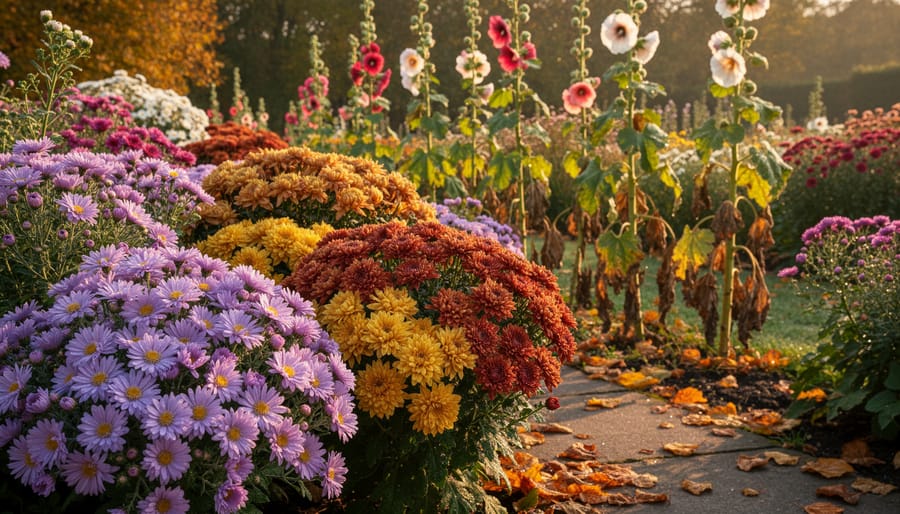
Quick-Growing Annuals for Last-Minute Gaps
When your hollyhocks start to look tired in late summer, quick-growing annuals can save the day and keep your garden colorful right up until frost. I learned this trick from my neighbor, who always has the most vibrant fall borders.
Zinnias make excellent last-minute additions because they grow incredibly fast and bloom within 60 days of sowing. Tuck seeds directly into the soil around your fading hollyhock stalks in early July, and you’ll have fresh blooms by September. They’re particularly useful zinnias as gap fillers because they don’t mind the competition and will happily grow in the dappled shade created by hollyhock foliage.
Marigolds are another reliable choice, germinating in just five to seven days. Their compact varieties work beautifully at the base of hollyhocks, creating a warm color transition from yellow to orange to rust. Cosmos, though more delicate-looking, are surprisingly tough and will self-sow for next year.
The key is planting these annuals while your hollyhocks still have some green growth left. This gives the new plants protection as they establish, and you’ll barely notice the transition as one generation of blooms fades into the next.
Rotation Strategies: Managing Hollyhocks Year After Year
Understanding hollyhocks’ biennial nature is key to keeping these beautiful bloomers in your garden year after year. In their first season, hollyhocks focus on developing strong root systems and lush foliage rosettes. The spectacular flower spikes appear in the second year, after which the plant typically completes its life cycle. However, with thoughtful planning, you can ensure continuous blooms without gaps in your garden display.
The simplest approach is embracing hollyhocks’ natural self-seeding habit. Allow some spent flower stalks to remain through autumn, letting seeds drop around the parent plants. You’ll notice new rosettes emerging by late summer or early fall, ready to bloom the following year. This creates a staggered succession where some plants are flowering while others are establishing themselves. Just remember to thin seedlings in spring, giving each plant about 18 to 24 inches of space.
For more control over placement, collect seeds in late summer and sow them where you want new plants to grow. I’ve found this particularly useful when rotating hollyhocks through different sections of a perennial border, allowing me to refresh soil in their previous location while they mature elsewhere.
Soil health deserves attention when growing hollyhocks in the same area repeatedly. These deep-rooted plants are heavy feeders, so amending soil with compost annually helps maintain fertility. Consider a three-year rotation plan: after hollyhocks finish blooming in one section, plant nitrogen-fixing legumes or shallow-rooted annuals there for a season or two before returning hollyhocks to that spot.
Master gardener Elena Rodriguez shared this wisdom with me: “I treat my self-seeded hollyhocks like volunteers in my vegetable garden. I let them pop up naturally, then transplant the strongest ones where I need vertical interest.” This flexible approach works beautifully when companion planting, allowing you to adjust your design as your garden evolves.
Problem-Solving: What NOT to Plant Near Hollyhocks
While hollyhocks are wonderfully accommodating companions for many plants, there are a few partnerships worth avoiding to keep your garden thriving. Understanding these incompatibilities helps you sidestep common companion planting mistakes and create a healthier growing environment.
First on the list are plants susceptible to rust disease, particularly members of the mallow family like hibiscus and other hollyhock varieties. Since hollyhocks are notorious for attracting rust fungus, clustering rust-prone plants together creates a disease superhighway. This doesn’t mean you can’t grow these plants at all, just keep them well-separated with good air circulation between them.
Avoid planting vegetables that need full sun directly beneath or very close to mature hollyhocks. Their towering height casts considerable shade, which can stunt the growth of sun-loving crops like tomatoes, peppers, and squash. I learned this lesson the hard way when my cherry tomatoes produced barely a handful of fruit after being overshadowed by enthusiastic six-foot hollyhocks!
Low-growing ground covers that prefer dry conditions, such as creeping thyme or sedum, won’t appreciate being planted immediately around hollyhock bases. These plants need different watering schedules and can struggle with the moisture hollyhocks require, especially during their active growing season.
Finally, be cautious with aggressive spreaders like mint or certain ornamental grasses. While they won’t directly harm hollyhocks, they’ll compete vigorously for resources and can quickly overwhelm your garden space, making it difficult to maintain the succession planting strategy that works so beautifully with hollyhocks. Give each plant the space and conditions it needs to truly flourish.
Your Hollyhock Succession Planting Calendar
Creating a succession planting calendar for your hollyhocks doesn’t have to be complicated. Think of it as orchestrating a beautiful garden performance where different plants take center stage throughout the year, with your stately hollyhocks as the midsummer stars.
Let’s walk through this season by season, starting in early spring when the ground becomes workable. This is when you’ll want to plant early bloomers around your hollyhock rosettes. Tuck in pansies, sweet alyssum, and snapdragons in March or early April. These cool-season companions will provide color while your hollyhocks are still gathering strength. I like to plant them about 12 to 18 inches away from the hollyhock base to avoid disturbing those developing roots.
By late April or early May, add your spring bulbs’ successors. Plant out lobelia, cosmos, and calendula seedlings. These will bridge the gap as temperatures warm and your hollyhocks start their upward climb.
Come June, your hollyhocks are shooting skyward. This is the perfect time to tuck in summer companions that will bloom alongside them. Plant zinnias, marigolds, and cleome at the base. Remember, these should go in front of your hollyhocks since they’re shorter.
As July and August arrive, your hollyhocks put on their spectacular show. Enjoy this peak period while planning ahead. In late August or early September, after hollyhock blooms fade, immediately plant fall-blooming companions like asters and ornamental kale in the spaces you’ll clear.
October is cleanup time. Remove spent hollyhock stalks and refresh mulch, but leave those second-year rosettes in place. Plant spring bulbs around them for next year’s early display.
Here’s a helpful tip from master gardener Elena Rodriguez, whom I interviewed last spring: “I mark my hollyhock locations with small stakes in fall so I remember where not to dig when planting spring bulbs. It’s saved many a young plant from accidental damage.”
This rotating calendar ensures your hollyhock beds never look bare or neglected.
Now comes the exciting part—putting everything you’ve learned into practice! The beauty of companion planting with hollyhocks is that there’s no single “right” answer. Your garden’s unique conditions, your personal style, and the microclimates in your space all play a role in what combinations will thrive.
I encourage you to start small if you’re new to succession planting. Perhaps try pairing spring bulbs with a few hollyhock plants this year, then expand your repertoire as you observe what works. Keep a simple garden journal noting what bloomed when, which combinations delighted you, and what you’d adjust next season.
One gardener I spoke with, Maria from Ohio, transformed a bare fence line into a year-round spectacle by experimenting with hollyhock companions. She started with just crocuses and delphiniums alongside her hollyhocks five years ago. Today, her garden flows seamlessly from early spring through fall frost, attracting neighbors who stop to admire the ever-changing display.
Remember, even experienced gardeners learn through trial and experimentation. Some plants won’t perform as expected, and that’s perfectly fine. Each season teaches you something new about your garden’s rhythms. With thoughtful planning and a willingness to adapt, you’ll create a garden that evolves beautifully, offering fresh visual interest and ecological benefits throughout the entire growing season.