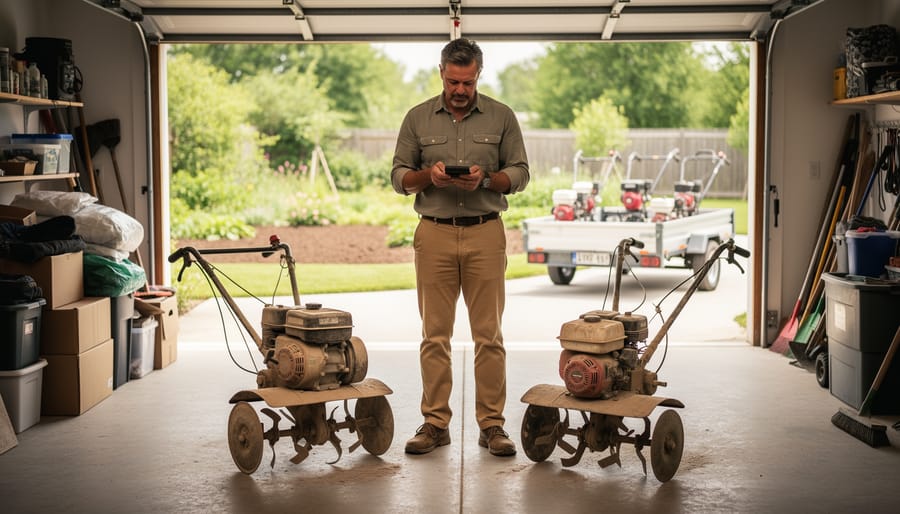
Divide your annual equipment usage hours by the rental rate per hour to find your break-even point—if you’ll use a tiller less than 20 hours yearly, renting at $50 per day beats buying a $600 model. Track every cost including delivery fees, fuel surcharges, and weekend rate premiums that rental companies add to base prices, since these hidden charges often push rentals 30-40% higher than advertised rates. Calculate your cost per garden project by adding rental duration, transportation expenses, and your time spent picking up and returning equipment—a $40 aerator rental becomes $75 when you factor in two hours of driving and gas. Compare at least three local rental shops and big-box stores, checking their damage policies and insurance requirements, because some charge $200+ for minor scratches while others offer free damage waivers. Consider seasonal timing in your calculations since spring equipment shortages can double prices, making winter purchases of used equipment surprisingly economical. Test whether multi-day rates offer better value than daily charges—a three-day pressure washer rental at $120 costs less per day than three separate daily rentals at $60 each, giving you flexibility to work around weather delays.
Why Garden Equipment Decisions Matter More Than You Think
Before we dive into the numbers, let’s talk about something that catches many gardeners off guard: the hidden reality of equipment ownership. That shiny rototiller at the garden center might seem like a great investment, but have you considered where you’ll store it for the 50 weeks a year you’re not using it?
Take my neighbor Sarah, for example. She bought a pressure washer three years ago to clean her deck and patio once each spring. It’s been sitting in her already cramped garage ever since, taking up valuable space alongside her holiday decorations and kids’ bikes. She recently calculated she’s paid about $75 per use when you factor in the purchase price and annual maintenance costs.
The truth is, most garden equipment sits idle far more than we anticipate. A rototiller might get pulled out twice a year for spring and fall garden prep. An aerator comes out once, maybe twice annually. Even that handy pressure washer typically sees action only a few times per season. Meanwhile, these tools need winterizing, blade sharpening, oil changes, and occasional repairs.
Storage presents another challenge that’s easy to overlook. These aren’t small hand tools you can hang on a pegboard. We’re talking about equipment that demands dedicated floor space in your garage, shed, or basement. In typical suburban homes where storage is already at a premium, that space comes at a real cost.
Then there’s maintenance. Small engines don’t like sitting idle. Gas goes stale, parts corrode, and when you finally need that aerator next spring, you might find yourself making an expensive repair run before you can even start your project. Suddenly, that ownership decision looks a lot different than it did in the store.


The Simple Formula to Calculate Your True Rental Costs
What to Include in Your Daily or Hourly Rental Rate
When you’re comparing rental options, understanding what’s bundled into that daily or hourly rate makes all the difference. Most rental companies structure their pricing in tiers, similar to how you might choose between basic and premium plant varieties at your local nursery.
The base rate typically covers just the equipment itself. For example, a local rental shop I visited recently charges $45 per day for a gas-powered tiller, but that’s before additional fees. You’ll often encounter delivery charges ranging from $25 to $75 depending on distance, which can significantly impact your budget if you don’t have a suitable vehicle for transport. Fuel charges are another consideration—some companies provide equipment with a full tank and expect it returned the same way, while others charge a refueling fee of $10 to $20.
Don’t forget about deposits, which commonly range from $50 to $200 for garden equipment. Think of it as a security blanket for the rental company. At The Home Depot and Sunbelt Rentals, for instance, you’ll find they require a credit card hold rather than cash deposits, making the process smoother. Some smaller, community-focused rental shops offer weekend specials that bundle Saturday and Sunday at reduced rates, which is perfect for those bigger garden projects. Always ask about package deals—they’re surprisingly common and can save you 15 to 25 percent compared to single-day rates.
Hidden Costs That Catch Gardeners Off Guard
When you’re calculating rental costs, don’t forget those sneaky extras that can quickly inflate your bill. Insurance or damage waivers typically add 10-15% to your daily rate, but they’re often worth the peace of mind, especially for expensive equipment like tillers or stump grinders.
Late fees are the biggest budget buster I’ve encountered. Most rental companies charge by the hour once you’re past your return time, and it adds up fast. My tip? Set a phone alarm for two hours before your return time. This gives you plenty of cushion to finish up and get everything back on schedule.
Cleaning charges catch many gardeners by surprise. If you return a sod cutter caked in mud or a power washer covered in dirt, expect a $25-50 cleaning fee. Take ten minutes to hose down equipment before returning it—this simple step has saved me hundreds over the years.
Fuel policies vary too. Some companies require you to return equipment with a full tank, while others charge a flat refueling fee. Always ask upfront and factor this into your calculations. These hidden costs can add 20-30% to your quoted rental price, so plan accordingly.
How Often Will You Actually Use It?
Be honest with yourself about how frequently you’ll actually need that equipment. If you’re planning to aerate your lawn, this typically happens once or twice a year at most. A rototiller might see action during spring garden prep and perhaps once more in fall. Grab your gardening calendar and count the actual days you’ll need each tool.
Consider your project timeline too. Are you tackling a one-time landscape renovation or maintaining ongoing garden beds? For occasional tasks like stump grinding or power washing your patio before the growing season, renting makes perfect sense. However, if you find yourself needing a power edger every two weeks throughout the growing season, those rental fees add up quickly.
Think seasonally as well. Many gardeners get excited about equipment in spring but forget that lawns and gardens need care from March through October in most climates. That’s roughly 32 weeks where certain tools become essential.
The Purchase Price is Just the Beginning
Upfront Investment and Financing Reality
Before deciding whether to rent or buy, let’s look at realistic purchase prices. A quality lawn mower ranges from $300-$800, while a pressure washer costs $150-$400. Tillers typically run $200-$600, and leaf blowers start around $100. Here’s the good news: timing matters! Shop end-of-season sales in late fall for mowers and spring equipment, or wait until late summer for deals on trimmers and blowers. You can often save 30-50% by being patient.
Financing through store credit cards might seem tempting, but those interest rates can quickly inflate your costs. Instead, consider setting aside equipment savings monthly or exploring garden rebates and grants that might cover part of your purchase. A zero-interest payment plan during promotional periods can work if you’ll definitely pay it off before regular rates kick in.
Maintenance Costs Nobody Warns You About
Here’s what equipment ownership really costs beyond the purchase price. Let’s say you buy a quality rototiller for $800. Budget around $50-75 annually for oil changes and air filter replacements. Blade sharpening for mowers and tillers typically runs $15-30 per sharpening, and most equipment needs this 2-3 times per season if you’re using it regularly.
Winterization is another hidden expense many first-time buyers overlook. Properly storing equipment means stabilizing fuel, lubricating parts, and sometimes battery maintenance, costing $30-60 per machine. Then there are unexpected repairs. A broken belt here, a carburetor cleaning there—these add up quickly. Set aside at least $100-150 annually for surprise fixes.
For a mid-range rototiller or lawn mower, you’re looking at $200-300 yearly in maintenance alone. Compare this to rental costs before committing. Sometimes renting means someone else handles all these headaches while you just enjoy your gardening projects.

Storage and Space Considerations
Here’s something many gardeners overlook when comparing rental versus purchase costs: where will you actually keep that equipment? If you’re renting a tiller once or twice per season, storage isn’t your problem. But buying means you’ll need dedicated space that stays dry and secure.
Think about your current setup. A compact garage might accommodate smaller tools like a power edger, but a riding mower or chipper needs serious real estate. Without proper weather protection, even quality equipment deteriorates quickly. Rust, engine problems, and cracked plastic housings can develop surprisingly fast when tools sit exposed to the elements.
If you lack adequate storage, factor those hidden costs into your calculations. Building a shed or renting storage space can add hundreds to your annual expenses. Sometimes the rental option wins simply because it includes climate-controlled storage and maintenance in the price you already pay.
Resale Value and Equipment Lifespan
Equipment lifespan varies significantly across garden tools. A quality tiller typically lasts 10-15 years with proper maintenance, depreciating about 15-20% annually. Smaller power tools like trimmers hold value for 5-7 years. When calculating rental rates, factor in that well-maintained equipment retains 30-40% resale value. Consider buying secondhand equipment to reduce initial costs, especially for seasonal tools you’ll use infrequently. This helps you understand the true cost of ownership versus renting.
Your Quick Decision Calculator for Common Garden Equipment
Occasional-Use Tools (Aerators, Dethatchers, Stump Grinders)
Some garden tools are like that special cake pan you pull out once a year – wonderful to have, but hard to justify buying. Let me share how to think about equipment you’ll rarely use.
Here’s the golden rule: if you use specialized equipment fewer than three times annually, renting almost always wins. A power dethatcher costs around $1,500 to purchase but only $75 to rent for a day. Since most lawns need dethatching just once yearly in spring, you’d need 20 years of ownership to break even. That’s a long time for equipment that requires maintenance and storage space.
Stump grinders present an even clearer case. These heavy-duty machines rent for $150-250 daily but cost $3,000-15,000 to buy. Unless you’re removing dozens of stumps, renting is the obvious choice.
For aerators, consider this: a quality core aerator costs $800-2,000, while renting runs $60-90 per day. If you aerate twice yearly, that’s $120-180 in rental costs versus years of ownership expenses, storage headaches, and depreciation.
The beauty of renting occasional-use equipment is flexibility. You’ll always have access to well-maintained, current models without the burden of ownership. Plus, that garage space stays free for your everyday gardening essentials.
Seasonal Equipment (Rototillers, Power Seeders, Log Splitters)
Seasonal equipment is a smart rental category for most gardeners because you’ll only need these tools for brief periods each year. Let’s look at how the numbers work in your favor.
A quality rototiller costs around $800 to purchase, but you might only need it twice annually for spring and fall garden preparation. If you rent for $75 per day and complete your tilling in one day each season, that’s $150 yearly. Even with delivery fees of $30 per rental, you’d reach $360 annually, meaning it would take over four years to match the purchase price. Plus, you avoid maintenance costs and storage hassles.
Power seeders follow a similar pattern. These specialized tools excel at overseeding lawns but sit idle most of the year. At $60 for a four-hour rental versus $400 to buy, renting makes sense unless you’re maintaining multiple properties or planning a lawn care business.
Log splitters present an interesting case for firewood enthusiasts. At $90 per day to rent, if you’re processing firewood just once or twice yearly, renting remains cost-effective compared to a $1,200 purchase. However, if you heat primarily with wood and split multiple cords annually, buying might justify itself within two to three seasons.
Consider your actual usage days per year when making these calculations.
Frequent-Use Tools (Pressure Washers, Chippers, Tillers)
Let’s look at equipment you might use regularly throughout the gardening season. Pressure washers are perfect for this calculation—you might need one to clean your patio, deck, and outdoor furniture multiple times each spring and summer.
If you rent a pressure washer for $75 per day and use it four times a year, that’s $300 annually. A decent residential pressure washer costs around $250-400, meaning you’d break even after just one or two years. I learned this lesson myself after renting three times in one season!
The same math applies to wood chippers. Renting costs about $100 per day, so if you’re chipping prunings more than three times yearly, purchasing a $300-400 chipper makes financial sense.
Tillers present an interesting case. Rental rates run $60-80 daily, but a quality tiller costs $400-600. If you till your vegetable beds twice annually, you’d need three years to justify buying. However, owning means you can work your garden beds whenever weather permits, rather than planning around rental availability.
Here’s my simple rule: If you’ll use equipment more than three times annually for several years, purchasing usually wins. Track your first-year rentals carefully—those receipts tell you exactly when ownership becomes worthwhile.
The Questions That Make Your Decision Crystal Clear
Before you punch numbers into a calculator, let’s have a heart-to-heart about what really matters for your garden project. These questions will help you see your situation more clearly.
First, ask yourself: How often will I actually use this equipment? Be honest here. That rototiller might seem essential now, but will it gather dust after you’ve prepared your spring beds? If you’ll only need it once or twice a year, renting usually wins.
Next, consider your comfort level. Are you confident operating heavy machinery, or would you prefer trying it out before committing? Renting gives you a test drive without the pressure of ownership. I’ve met gardeners who rented a chipper-shredder only to discover they preferred composting the old-fashioned way.
Think about storage too. Where will you keep a large piece of equipment? Sheds fill up fast, and outdoor storage can shorten equipment lifespan significantly.
What about your garden’s future? Are you planning to expand, or is this a one-time project? If you’re gradually transforming your entire yard, ownership through strategic purchase planning might serve you better.
Finally, consider maintenance. Do you enjoy tinkering and performing upkeep, or would you rather leave that to someone else? Rental equipment comes maintained and ready to work, while owned equipment needs your ongoing attention.
These questions aren’t meant to complicate things. They’re simply helping you align your decision with your actual gardening life, not an imaginary one.
When Renting is Your Best Friend
Renting becomes your best friend when you need specialized equipment for occasional tasks. Take Sarah’s story: she needed to level her bumpy lawn for a new flower bed. A walk-behind sod cutter would’ve cost $2,800, but she only needed it for one weekend. By renting for $95, she saved thousands and didn’t sacrifice precious shed space.
Consider renting when you’re facing a one-time project, testing equipment before buying, or tackling seasonal work. Michael rented different tiller models over three springs before finally purchasing the perfect one for his soil type. This try-before-you-buy approach saved him from an expensive mistake.
To maximize rental value, plan your project thoroughly before picking up equipment. Measure your space, prepare the area, and schedule helpers if needed. Many rental shops offer half-day rates, so finishing efficiently saves money. Don’t forget to ask about delivery options for heavy items like stump grinders or aerators.
Pro tip: Rent during weekdays when possible. Some shops offer midweek discounts since weekends are busiest. And always inspect equipment before leaving the rental yard to avoid being charged for existing damage.
When Buying Actually Saves You Money and Headaches
Sometimes buying that tiller or chainsaw is genuinely the smarter choice, and it’s worth celebrating that decision! If you’re tackling regular projects or have a side hustle like maintaining community gardens or helping neighbors with their yards, ownership pays for itself surprisingly quickly. I’ve known gardeners who invested in quality equipment and found it became a source of pride and even modest income.
Consider the equity factor too. A well-maintained, professional-grade tool retains value and can be resold when you’re done with it. That rental money? It’s gone forever. Plus, there’s something satisfying about knowing your tools inside and out, being able to maintain them properly, and having them ready whenever inspiration strikes.
Community tool libraries are another wonderful option gaining popularity. Some neighborhoods organize shared equipment programs where members contribute to purchase high-quality tools everyone can access. This combines the benefits of ownership with cost-sharing, creating stronger community bonds along the way. If you’re considering a purchase, think about whether neighbors might want to split the cost and share access. You’ll all save money while building relationships and keeping quality equipment circulating where it’s needed most.
Here’s the truth: there’s no magical formula that works for every gardener and every situation. Your decision will be as unique as your garden itself! Whether you choose to rent or buy depends on your specific projects, budget, and long-term goals. The frameworks we’ve shared are simply tools to help you think through the numbers in a way that makes sense for your gardening journey.
Remember, making informed decisions doesn’t mean making perfect ones. It means understanding the trade-offs and choosing what feels right for you. If you’re standing at the garden center wondering whether to invest in that tiller or aerator, you now have the confidence to calculate whether it’s worth it.
For first-time projects, I encourage you to start with rentals. There’s absolutely no shame in testing equipment before committing to ownership. You’ll learn what features matter most to you, get a feel for maintenance requirements, and complete your project without the pressure of a major investment. As you continue planning your garden purchases, you’ll naturally discover which tools deserve a permanent spot in your shed. Trust yourself and happy gardening!