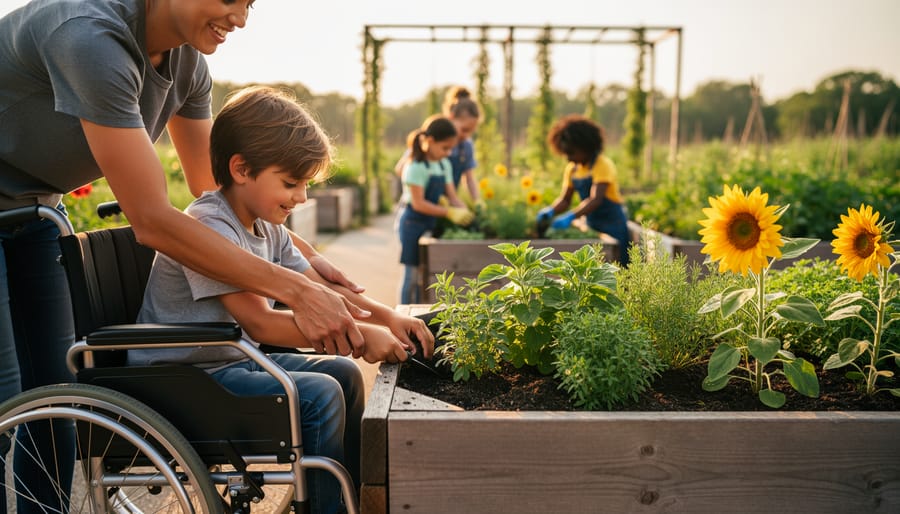
Transform your outdoor space into an inclusive learning environment by selecting plants with varied textures like fuzzy lamb’s ear, smooth succulents, and bumpy gourds that engage multiple senses while accommodating children who may be tactile-defensive or sensory-seeking. Create raised beds at wheelchair-accessible heights of 24-30 inches, ensuring pathways measure at least 48 inches wide for easy navigation, and incorporate vertical gardening structures that bring plants within reach for children with mobility challenges.
Choose fast-growing, forgiving plants such as sunflowers, cherry tomatoes, and radishes that provide quick success and maintain children’s interest across different developmental abilities. Pair these with fragrant herbs like mint and basil, which offer olfactory stimulation perfect for sensory integration activities. Adaptive tools make all the difference: lightweight watering cans with two handles, chunky-grip trowels, and brightly colored tools with textured grips help children with fine motor difficulties participate fully.
Design garden zones that serve specific therapeutic purposes. A quiet corner with soft grasses and gentle wind chimes supports children needing calming spaces, while a digging pit filled with different soil textures satisfies exploratory needs. Incorporate gardening activities for young children that break tasks into manageable steps, using visual schedules and social stories to prepare students for each gardening session.
Safety considerations matter tremendously: avoid thorny or toxic plants, secure all pathways, and establish clear boundaries using colorful edging. This thoughtful approach creates meaningful outdoor experiences where every kindergartner, regardless of ability, discovers the joy of watching seeds transform into thriving plants they’ve nurtured themselves.
Understanding the Special Benefits of Garden-Based Learning

Sensory Integration Through Natural Touch
Garden activities offer incredible opportunities for children who experience sensory processing challenges. The natural textures found in a kindergarten garden provide gentle, varied input that helps develop sensory integration skills in an unstructured, playful way.
Working with cool, crumbly soil gives children tactile experiences they can control at their own pace. Some kids love plunging their hands deep into the earth, while others prefer using tools initially. Both approaches are valuable. Water play during garden time adds another dimension—pouring from watering cans, feeling mist from spray bottles, or touching damp leaves all provide different sensory feedback.
Plant textures range from fuzzy lamb’s ear leaves to smooth tomato skins, offering safe exploration of varied surfaces. Creating sensory gardens for special needs children allows you to intentionally include plants with diverse textures, scents, and visual appeal.
The beauty of garden-based sensory work is its flexibility. Children can engage deeply or briefly, return to favorite activities, and follow their curiosity. There’s no pressure to perform—just opportunities to touch, explore, and discover at their own comfortable pace, building positive associations with sensory experiences that might otherwise feel overwhelming.
Building Fine and Gross Motor Skills Naturally
Gardening naturally incorporates movements that strengthen little hands and bodies without children even realizing they’re building crucial skills. When kindergarteners dig into soil with their fingers or small trowels, they’re developing the fine motor control needed for writing and buttoning clothes. The pinching motion of picking up seeds strengthens the same muscles used for holding pencils.
I’ve watched children who struggled with grip strength absolutely light up when watering plants with spray bottles. That squeezing action is fantastic therapy disguised as fun, and you can adjust bottle resistance based on each child’s abilities. Larger watering cans with two handles let kids work on bilateral coordination while feeling proud of their important job.
Digging, raking, and pushing wheelbarrows build gross motor skills and core strength. These whole-body movements help children develop balance and coordination naturally. Even something as simple as carrying pots from one spot to another challenges spatial awareness and body control.
For children with limited mobility, raised beds at wheelchair height still offer opportunities for reaching, scooping, and transferring soil. One occupational therapist I spoke with mentioned how she uses different soil textures in containers at various heights, letting children stretch and bend at their own pace.
The beauty of garden-based movement is that children repeat these motions willingly because they’re invested in seeing their plants grow. There’s no need to convince them to practice—the garden itself becomes the motivation.
Designing Your Special Needs-Friendly Kindergarten Garden
Accessibility Essentials: Pathways and Raised Beds
Creating an inclusive kindergarten garden starts with thoughtful pathways and planting areas that welcome every child, regardless of their physical abilities. When designing accessible garden design, aim for paths at least 4 feet wide to accommodate wheelchairs, walkers, and side-by-side exploration with buddies or helpers.
Smooth, firm surfaces work best—think compacted gravel, rubber mulch, or poured rubber rather than wood chips that can catch wheels or make walking difficult. Gentle slopes instead of steps ensure everyone can navigate independently, and clearly defined edges help children with visual impairments follow the path confidently.
Raised beds transform the gardening experience for children with mobility challenges. Build beds 24 inches high for wheelchair users, allowing easy reach without strain. For children who prefer standing or use supportive equipment, 30-inch heights work wonderfully. Make beds no wider than 2 feet so little arms can reach the center without stretching uncomfortably.
I recently spoke with Sarah Chen, an occupational therapist who gardens with special needs students. She suggests creating multiple bed heights in one garden space. “Some children feel most secure sitting on the ground,” Sarah explained, “while others thrive at table height. Offering choices empowers every child to participate in ways that feel comfortable.”
Consider adding sturdy railings or grab bars near planting areas for children who need extra stability. Wide, flat edges on raised beds double as seating spots, giving children natural rest breaks during longer activities.

Safety Features That Don’t Feel Restrictive
Creating a safe garden space doesn’t mean limiting your kindergarteners’ exploration and joy. Start with low, visible fencing that defines the garden boundaries without feeling cage-like. Picket fences or rope borders work beautifully, allowing children to see out while understanding their play area.
Choose exclusively non-toxic plants, even if a curious child decides to taste-test a leaf. Sunflowers, snapdragons, nasturtiums, and marigolds are wonderful options that won’t cause harm. Keep a posted list of your safe plants near the garden entrance for all caregivers to reference.
Pay attention to edges throughout your space. Raised beds should have rounded corners and smooth surfaces. Avoid metal edging with sharp lips, opting instead for untreated wood or composite materials that won’t splinter. Check regularly for any protruding nails or rough spots.
Tool storage deserves thoughtful planning. Designate child-sized tools that little hands can actually manage, storing them at accessible heights in a clearly marked spot. Keep adult tools and any pointed implements in a separate, secured area. Shadow boards with tool outlines help children develop independence while maintaining organization. This approach teaches responsibility while keeping everyone safe and engaged in their gardening adventures.
Creating Calming and Stimulating Zones
When designing your kindergarten garden for special needs children, think of it as creating different “rooms” outdoors. Just as indoor classrooms have quiet corners and active play areas, your garden should offer variety.
Start by establishing a peaceful retreat zone. A small canopy of flowering vines over a bench, surrounded by soft lavender or chamomile, gives overwhelmed children a place to decompress. One special education teacher I spoke with shared how her “calm corner” with its simple wooden bench became a sanctuary for students needing sensory breaks.
Balance this with stimulating areas featuring bright sunflowers, rustling ornamental grasses, and textured plants like lamb’s ear. These sensory-rich spots encourage exploration and engagement. The key is visible separation between zones, perhaps using low hedges or colorful garden edging, so children can easily identify where to go based on their needs.
Consider adding a small water feature in the quiet zone for gentle sound, while placing wind chimes and pinwheels in the active area. This thoughtful layout respects that every child processes sensory input differently, giving them autonomy to choose their experience while building confidence in understanding their own needs.
Best Plants for Special Needs Kindergarten Gardens
Touch-Friendly Sensory Plants
Touch-friendly plants transform any kindergarten garden into an interactive sensory wonderland that encourages safe, hands-on exploration. These tactile treasures invite little fingers to discover different textures while supporting fine motor development and curiosity.
Lamb’s ear tops the list with its impossibly soft, velvety leaves that children can’t resist petting. This forgiving perennial thrives in various conditions and handles frequent touching beautifully. Nearby, plant fuzzy sage varieties whose textured foliage provides a contrasting sensory experience. Mint offers smooth, cool leaves that release wonderful scents when gently rubbed, adding an olfactory dimension to tactile exploration.
For children with sensory processing differences, offering diverse textures helps them gradually explore comfort zones at their own pace. Some may prefer the gentle smoothness of mint, while others gravitate toward lamb’s ear’s plush softness.
Create designated “touching stations” with clear visual markers showing which plants welcome interaction. This simple strategy helps children learn boundaries while building confidence in their explorations. Consider planting these sensory favorites in raised beds at wheelchair-accessible heights, ensuring every child can participate fully.
Remember that even safe plants require supervision during initial introductions. Watch for individual sensitivities and always encourage gentle touching rather than picking or pulling. With thoughtful selection and placement, these tactile plants become beloved garden companions that grow alongside your young explorers.
Fast-Growing Confidence Builders
Nothing builds confidence quite like watching a seed transform into something you can see, touch, or even eat within days or weeks. For young learners with special needs, these quick wins are absolutely essential. Radishes are the superstars here, popping up in just 25-30 days with bright colors that capture attention. The large seeds are easy for small hands to grip and plant, making them perfect for practicing fine motor skills.
Sunflowers bring pure joy with their giant blooms and sturdy stems that children can measure as they shoot skyward. Choose dwarf varieties that grow to about three feet, making them manageable for little gardeners to tend without assistance. The large seeds are wonderfully tactile and simple to handle, even for children with limited dexterity.
Bush beans offer another speedy reward, germinating in about a week with leaves big enough to spot easily. They’re forgiving plants that tolerate a bit of rough handling, which takes the pressure off perfection. Lettuce grows quickly too, and many varieties come in fascinating colors like deep purple or speckled green. Children can start harvesting outer leaves in just three weeks, creating an ongoing cycle of accomplishment that reinforces their gardening efforts and keeps motivation high throughout your growing season.
Plants to Absolutely Avoid
Safety comes first when gardening with young learners, especially those with special needs who may explore plants through touch and taste. Start by removing oleander, foxglove, castor bean, and daphne—all contain toxins that can cause serious harm if ingested. Roses, blackberries, and cacti pose injury risks with their thorns and spines, making them poor choices for sensory exploration.
Plants with strong allergens like chrysanthemums and certain ornamental grasses can trigger reactions in sensitive children. Avoid trumpet vine and wisteria, which grow aggressively and create tripping hazards. Skip plants with irritating sap such as euphorbias and giant hogweed. Lily of the valley looks charming but every part is poisonous.
Instead, focus on kid-safe herbs, vegetables, and flowers that invite exploration without worry. When planning your garden space, always research plants thoroughly and consider each child’s specific sensitivities and tendencies.
Adapting Garden Activities for Different Abilities
Modified Tools and Equipment
Finding the right tools can transform gardening from a frustrating challenge into a joyful, confidence-building experience for kindergarteners with special needs. Just as adaptive gardening tools help adults garden comfortably, modified equipment empowers young learners to participate fully.
Look for child-sized tools with chunky, textured grips that are easier to hold and control. Foam pipe insulation wrapped around standard handles creates an instant adaptation for little hands with weaker grip strength. Lightweight plastic trowels and scoops reduce fatigue and are safer than metal alternatives.
Consider creative substitutions that work beautifully. Large serving spoons make excellent diggers, measuring cups become perfect seed scoops, and spray bottles with easy-squeeze triggers offer satisfying watering practice. Paint rollers dipped in water create fun patterns while watering seedlings, turning a task into sensory play.
For children who struggle with traditional tools, think beyond the basics. Cookie cutters pressed into soil create perfect planting holes. Turkey basters help with precise watering. Even a simple bucket with rope handles allows two children to work together, building cooperation skills.
The goal is independence and success, so experiment until you find what clicks for each child.

Visual Schedules and Communication Supports
Visual supports transform garden time into a predictable, joyful experience for young learners with diverse needs. Picture cards showing each garden task—watering, planting, harvesting—help children understand what comes next, reducing anxiety and increasing independence.
Create a simple visual schedule by photographing your actual garden space and activities. Laminate these photos and attach them to a board with Velcro, allowing children to move cards as they complete each step. One kindergarten teacher I interviewed shared how her students loved removing completed task cards and placing them in a “finished” pocket, building confidence with each small success.
Color coding works beautifully in the garden. Assign each child a specific color for their tools, plant markers, and watering can. This simple system helps children locate their supplies quickly and prevents confusion during group activities.
Consider using first-then boards for transitions: “First we pull weeds, then we water.” These concrete sequences give children clear expectations. You might also display a feelings chart near your garden space, helping youngsters identify emotions that arise during garden work.
Remember, these visual supports benefit all children, not just those with special needs. They create structure that allows everyone to participate more fully and enjoy the magic of watching plants grow.
Pacing Activities for Different Processing Speeds
Every child processes information differently, and that’s perfectly wonderful in the garden! Think of gardening tasks as bite-sized adventures. Instead of “plant a seed,” break it down: first we touch the soil, then we make a small hole, then we drop one seed in, and finally we cover it gently. Some children zoom through these steps while others need more time to absorb each action.
Create visual step cards using simple pictures or photos showing each mini-task. One kindergartener I met needed five minutes between steps to watch butterflies and process what came next, while his friend completed the whole sequence in two minutes. Both approaches worked beautifully because their teacher offered flexible timing without pressure.
Consider offering “quick tasks” like watering with spray bottles alongside “longer explorations” such as examining worms in compost. This way, children can self-select based on their energy and processing needs that day. Remember, there’s no race in the garden. Some kids will plant three seeds while others plant one, and both experiences are equally valuable. The goal is engagement and joy, not completion speed.
Step-by-Step: Your First Special Needs Kindergarten Garden Project
Let me walk you through creating a wonderful first container sensory garden that I’ve seen work beautifully time and time again with kindergarteners of all abilities. This project takes about an hour to complete and provides months of sensory-rich exploration.
What You’ll Need:
Start with one large shallow container, about 18 inches wide and 8 inches deep. Plastic or resin works better than ceramic since they’re lighter and won’t break if tipped. You’ll also need potting soil, three types of plants with different textures, small smooth stones, and gardening gloves sized for little hands.
Plant Selection for Success:
Choose lamb’s ear for its incredibly soft, fuzzy leaves that children love to touch. Add sweet basil for a wonderful scent when leaves are gently rubbed, and include miniature sedums for their interesting bumpy texture. These three plants grow easily, tolerate occasional overwatering or underwatering, and provide distinct sensory experiences without thorns or toxicity concerns.
Step-by-Step Assembly:
First, let children help pour soil into the container, filling it about two-thirds full. This messy part is actually therapeutic, developing fine motor skills while being forgiving of spills. Next, arrange your three plants in a triangle pattern, spacing them evenly. Children can help place plants in their holes and pat soil around them. This hands-on involvement creates ownership and investment in the garden’s success.
Add smooth stones around the base of each plant. These serve double duty as mulch and as tactile elements for children who benefit from manipulating objects while observing.
Making It Work:
Place your container where children can easily reach it from all sides. A low table or wide step works perfectly. Water thoroughly on day one, then check soil moisture every few days by having children touch the soil surface.
This simple project connects beautifully with other educational gardening activities you might explore later. The key is starting small and celebrating every success, whether that’s remembering to water, noticing new growth, or simply spending quiet time touching and observing the plants. Trust me, watching children discover the soft lamb’s ear for the first time never gets old.
Real Stories: How Gardens Transform Special Needs Learning
There’s something magical that happens when children with special needs get their hands in the soil. I’ve collected stories from educators and therapists who’ve witnessed these transformations firsthand, and their experiences speak volumes about the power of garden-based learning.
Sarah Martinez, an occupational therapist in Portland, shares a breakthrough moment: “We had a five-year-old student with autism who rarely made eye contact or initiated conversation. After three weeks of our garden program, he ran up to me holding a cherry tomato he’d grown himself, making direct eye contact and exclaiming, ‘Look what I made!’ His parents cried when I told them.”
Maria Chen, a special education teacher with 15 years of experience, discovered unexpected benefits in her kindergarten’s sensory garden. “One of my students with sensory processing disorder would typically avoid touching new textures. But watching his classmates gently handle lamb’s ear leaves, he eventually reached out on his own terms. By harvest time, he was confidently digging for carrots. That kind of self-initiated exposure is therapy gold.”
Physical therapist James Rodriguez uses raised garden beds to support children with motor delays. “I work with a little girl who struggled with bilateral coordination. Planting seeds with both hands, then later using both hands to steady watering cans, became her favorite ‘exercises.’ She didn’t realize she was in therapy because she was just having fun gardening with her friends.”
Perhaps the most heartwarming story comes from preschool aide Linda Thompson: “We have a nonverbal student who communicates through gestures. One day in the garden, she created her own sign for ‘butterfly’ after watching one land on our marigolds. She used that sign dozens of times that week, showing everyone her discovery. The garden gave her something she wanted to talk about.”
These aren’t isolated incidents. When we create accessible, sensory-rich garden spaces designed with intention, every child finds their own path to growth and connection.
Gardening truly holds transformative power for special needs kindergarteners, offering opportunities for growth that extend far beyond the garden bed. Through hands-on experiences with soil, seeds, and plants, every child can build confidence, develop new skills, and connect with nature in meaningful ways. The beauty of inclusive gardening lies in its flexibility—there’s no single right way to create a successful experience.
If you’re feeling overwhelmed, remember to start small. A single container garden or one sensory-friendly plant can be just as impactful as an elaborate garden plot. Begin with activities that match your child’s current abilities and interests, then gradually introduce new elements as their comfort level grows. The right adaptations, whether they’re raised beds for wheelchair access, visual schedules for predictability, or textured tools for better grip, make all the difference in creating an accessible experience.
Every child deserves the chance to watch something they’ve planted grow, to feel soil between their fingers, and to taste a fresh vegetable they’ve nurtured. With patience, creativity, and the strategies we’ve explored, you can cultivate not just plants, but also confidence, joy, and valuable life skills. Your gardening journey with special needs kindergarteners starts today—one seed, one smile, one success at a time.